Product Description
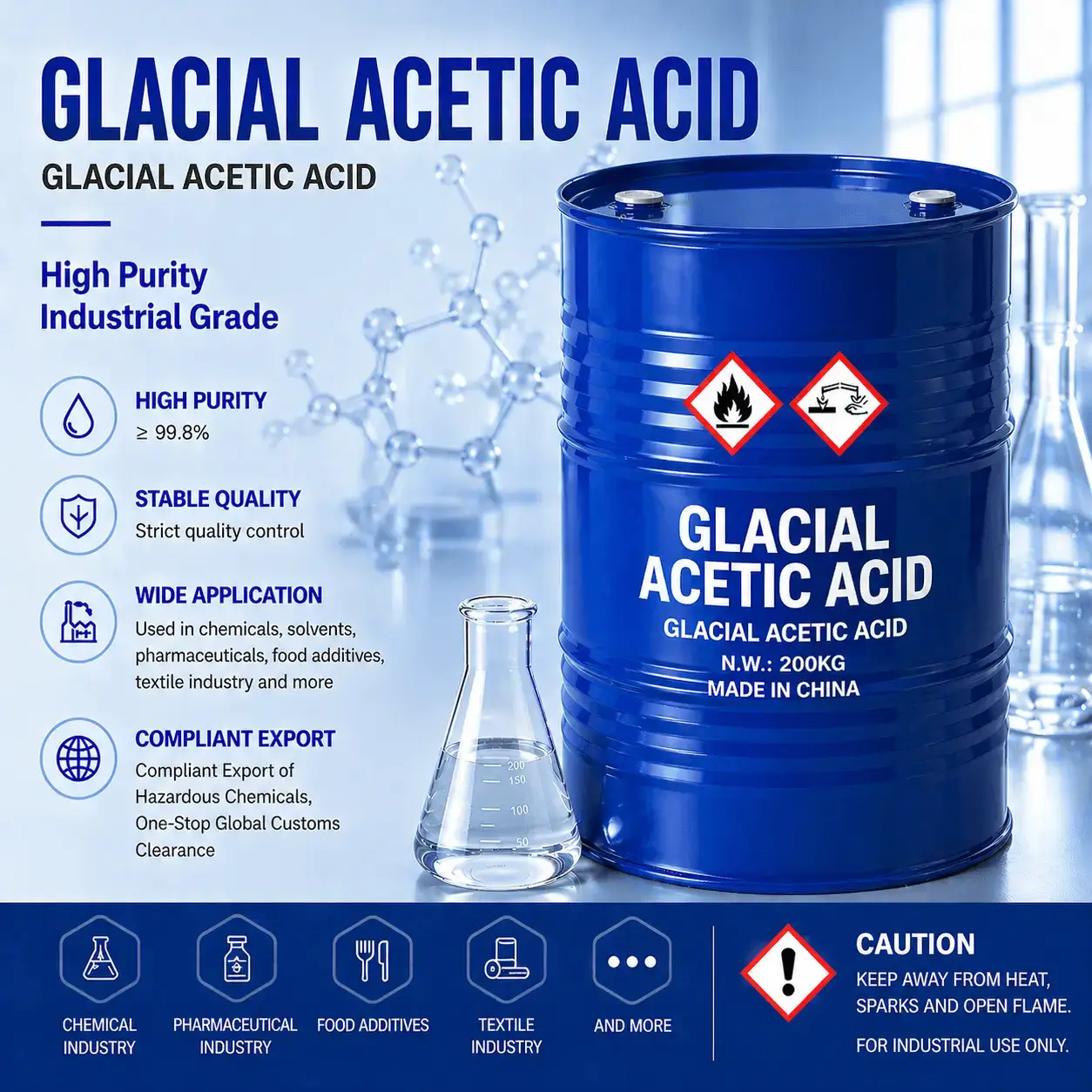
Glacial acetic acid (GAA) is a high-purity anhydrous acetic acid. When the temperature drops below 16.6°C, pure acetic acid solidifies into ice-like crystals, hence the name “glacial acetic acid.”
This product is a colorless, transparent liquid with a pungent acetic odor. It is highly volatile and miscible with water, ethanol, diethyl ether, and other organic solvents. Glacial acetic acid is an important organic chemical raw material widely used in the chemical, pharmaceutical, food, textile, and dyeing industries.
For detailed information on the physical and chemical properties of GAA, see 【Addition information】
Main Applications & Product Features
1.Product Features
• High purity, low color, low moisture content, and consistent quality
• Refined manufacturing process with low impurity levels, suitable for high-end synthesis
• Excellent solubility and stable reactivity
• High versatility with a wide range of downstream applications
2.Main Applications
• Acetate Production: Used to manufacture solvents such as ethyl acetate, butyl acetate, and isopropyl acetate, which are widely used in the coatings, inks, and adhesives industries.
• Acetate Fiber & PTA Industries: Used as a solvent and reaction feedstock in the acetate fiber and polyester industries (PTA / polyester chips).
• Pharmaceutical & Pesticide Intermediates: Used in the synthesis of various active pharmaceutical ingredients, pesticide intermediates, and organic chemical products.
• Food Additives: Refined grades can be used as food acidity regulators, preservatives, and flavorings (food-grade specifications must be specified separately)
• Water Treatment & Chemical Additives: Used in the preparation of acetate salts, buffers, cleaning agents, textile printing and dyeing auxiliaries, etc.
GHS Hazard Classification
| Category | Information |
| Flammable liquids | Category 3 |
| Skin corrosion/irritation | Category 1A |
| Serious eye injury/eye irritation | Category 1 |
Hazard Statement
H226: Flammable liquid and vapor
H314: Causes severe skin burns and eye damage
H318: Causes serious eye damage
Shipping Information
| Category | Information |
| UN Number | 2789 |
| Proper Shipping Name | Glacial Acetic Acid |
| Hazard Class | Class 8 (Corrosive substances) |
| Packaging Group | II |
| HS Code | 2915.21 |
Packaging Specifications
| Packaging Type | Specification |
| Plastic Drum | 200 kg |
| IBC Tote | 1000 kg / IBC |
| ISO Tank | 20 MT per tank |
| Small Package | 500mL、1L、2.5L、5L(customizable) |
Storage Requirements
• Temperature: 15–30°C; avoid low temperatures (solidifies below 16°C) and high temperatures
• Container material: Glass, HDPE, PP, or 316L stainless steel
• Ventilation: Store in a well-ventilated indoor area
• Sealing Requirements: Keep container tightly sealed to prevent evaporation and moisture absorption
• Separate Storage: Store separately from strong oxidizing agents, strong alkalis, and metal powders
• Warning Labels: Label with “Corrosive” and “Flammable Liquid” warnings
• Shelf Life: Industrial grade ≥99.5%: approx. 12 months; Food grade ≥99.8%: 6–12 months
Safety Precautions
• Respiratory protection: Wear a gas mask (with an organic vapor filter cartridge) in poorly ventilated areas; use a positive-pressure respirator in high-concentration environments
• Eye protection: Wear a face shield or safety goggles (EN 166 standard)
• Skin protection: Wear chemical-resistant gloves and protective clothing (required when concentrations exceed 10%)
• Workplace: Provide an eyewash station and emergency shower facilities (when concentrations exceed 5%)
Disclaimer
- Carefully read and follow the latest SDS provided with the product;
- Conduct a risk assessment according to actual use and local regulations;
- Implement appropriate safety measures and comply with all applicable hazardous chemical regulations.
We assume no liability for any direct or indirect loss, damage, or injury arising from the use or handling of this product. Users bear full responsibility and risk for its use.