Product Description
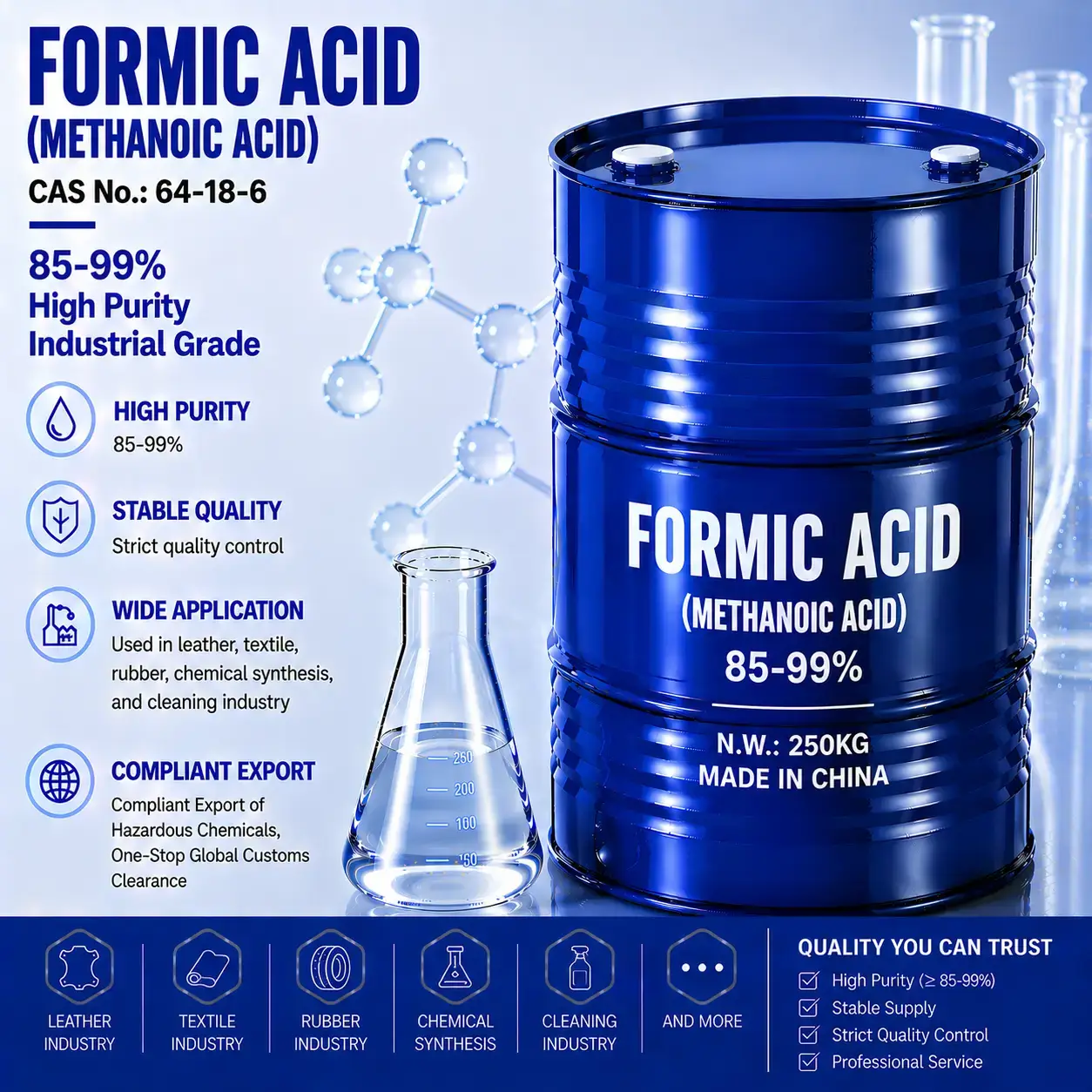
Formic acid, also known as methanoic acid, is the simplest aliphatic carboxylic acid and exhibits the dual chemical properties of both a carboxylic acid and an aldehyde. Formic acid is a colorless, transparent, fuming liquid with a strong, pungent acidic odor. It is highly volatile and miscible in any proportion with water, ethanol, diethyl ether, and other organic solvents. It is the strongest acid among organic acids and is highly corrosive to skin and metals. It is widely used in leather tanning, textile printing and dyeing, rubber vulcanization, metal rust removal, chemical synthesis, feed preservation, and as an intermediate in pharmaceuticals and pesticides.
For detailed information on the physical and chemical properties of Formic acid, see 【Addition information】
Main Applications
1. Leather Industry
• Specialized raw materials for leather tanning, degreasing, color fixation, and fur softening and preservation.
2.Textile Printing and Dyeing
• Mordants, pH adjusters, and dyeing aids for fabric finishing.
3.Metal Surface Treatment
• Rust removers, acid pickling and passivation agents, and cleaning and descaling aids for metals.
4.Rubber Industry
• Coagulants for natural rubber latex; processing aids for molding and forming.
5.Fine Chemical Synthesis
• Raw materials for the synthesis of pharmaceuticals, pesticides, and fragrances; reducing agents and catalysts.
6.Other Applications
• Preservatives for animal feed; cement setting accelerators; raw materials for industrial cleaning agent formulations.
GHS Hazard Classification
| Category | Information |
| Flammable liquids | Category 3 |
| Acute Toxicity—Inhalation | Category 3 |
| Acute toxicity—oral | Category 4 |
| Skin corrosion/irritation | Category 1A |
| Serious eye injury/eye irritation | Category 1 |
| Harm to the aquatic environment | Category 3 |
| Hazard statement | Danger |
Hazard Statement
H226: Flammable liquid and vapor
H302: Harmful if swallowed
H314: Causes severe skin burns and eye damage
H318: Causes serious eye damage
H331: Toxic if inhaled
H402: Harmful to aquatic life
Shipping Information
| Category | Information |
| UN Number | 1779 |
| Proper Shipping Name | Formic acid |
| Hazard Class | Class 8 (Corrosives) Class 3 (Flammable Liquids) |
| Packaging Group | II |
| HS Code | 2915.11 |
Packaging Specifications
| Packaging Type | Specification |
| HDPE | 25 kg、35 kg、250 kg |
| IBC Tote | 1200 kg / IBC |
| ISO Tank | 20 MT |
| Small Package | customizable |
Storage Requirements
• Temperature Requirements: Store in a cool, dry place at a temperature of ≤25°C; for high-concentration solutions (≥95%), prevent crystallization by maintaining a temperature above 8°C
• Container Requirements: Use corrosion-resistant containers (HDPE, stainless steel, or PTFE-lined); store in a sealed container to prevent volatilization and moisture absorption
• Ventilation Requirements: Store in a well-ventilated area, away from heat sources, sparks, and open flames
• Incompatible Substances: Keep away from oxidizers, strong alkalis, alkaline substances, cyanides, and sulfiding agents
• Safety Precautions: Provide emergency showers, eye wash stations, and fire extinguishing equipment; operators must wear protective gear
Safety Precaution
• Respiratory protection: ABEK-type (EN 14387) respirators; use positive-pressure respirators when concentrations exceed limits
• Eye protection: Face shield or goggles splash guard
• Hand protection: Formic acid-resistant gloves (butyl rubber, fluorocarbon rubber)
• Body protection: Chemical-resistant coveralls, apron, protective boots
Disclaimer
- Carefully read and follow the latest SDS provided with the product;
- Conduct a risk assessment according to actual use and local regulations;
- Implement appropriate safety measures and comply with all applicable hazardous chemical regulations.
We assume no liability for any direct or indirect loss, damage, or injury arising from the use or handling of this product. Users bear full responsibility and risk for its use.