Product Description
Aniline, also known as aminobenzene or aniline oil, is the simplest aromatic amine compound. At room temperature, it is a colorless to pale yellow oily liquid with a distinctive odor; it oxidizes easily in air or under light, gradually turning brown or reddish-brown. Aniline is volatile with water vapor and is miscible with most organic solvents, such as ethanol, diethyl ether, and chloroform.
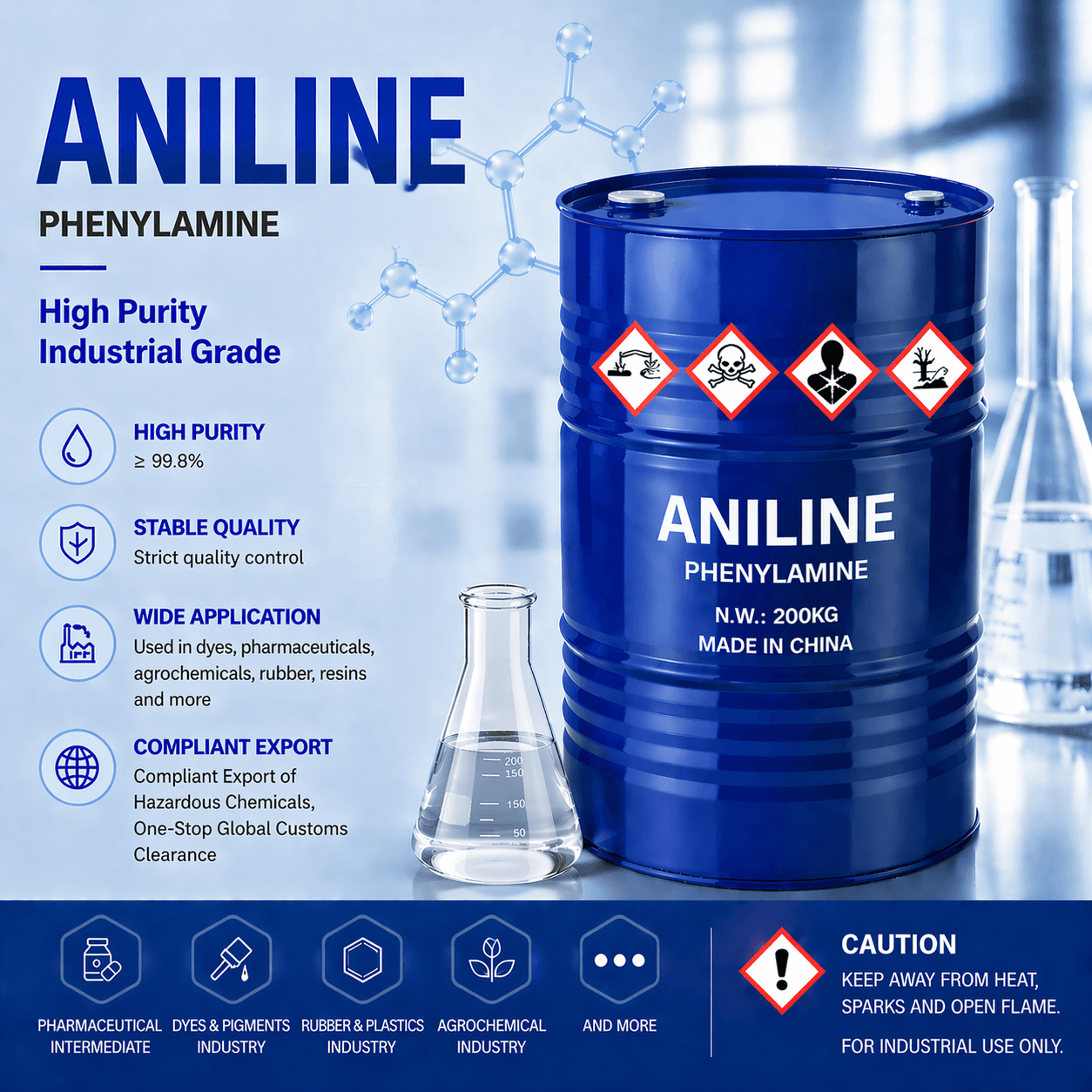
Aniline is an important chemical raw material and intermediate, widely used in the fields of dyes, pharmaceuticals, pesticides, rubber additives, and MDI polyurethane.
For detailed information on the physical and chemical properties of Aniline, see 【Addition information】
Main Applications & Product Features
1.Product Features
• High purity up to 99.8%, low impurity, stable quality for advanced synthesis.
• A representative product of the aromatic amine class, it is highly reactive and serves as a key starting material for numerous fine chemical products.
• Widely used in a variety of industries, including dyes, pharmaceuticals, pesticides, rubber additives, resins, and other additives.
• Excellent solubility and reactivity in various organic synthesis reactions.
2.Main Applications
• Aniline is the main raw material for MDI production, used in polyurethane foam, elastomers, coatings and adhesives.
• Important intermediate for azo dyes and sulfur dyes, used in textile, leather, paper industries.
• Intermediate for synthesizing various insecticides, herbicides and fungicides.
• Raw material or intermediate for synthesizing various drugs such as analgesics and antipyretics.
• Used in production of rubber accelerators and antioxidants.
• Important raw material for various organic synthesis reactions.
• Used as solvent and extractant.
• Used in GC, HPLC and other analytical testing.
GHS Hazard Classification
| Category | Information |
| Hazards to the aquatic environment—chronic toxicity | Category 1 |
| Hazards to the aquatic environment—acute toxicity | Category 1 |
| Target organ toxicity—repeated exposure | Category 1B |
| Eye injury/eye irritation | Category 1 |
| Skin sensitization | Category 1 |
| Carcinogenicity | Category 2 |
| Germline mutagenicity | Category 2 |
| Acute Toxicity—Inhalation | Category 3 |
| Acute Toxicity—Skin | Category 3 |
Hazard Statement
H301H311H331: Ingestion, skin contact, or inhalation may cause poisoning
H317: May cause skin allergic reactions
H318: causing serious eye injury
H341: Suspected of causing genetic defects
H351: Suspected of causing cancer
H372: Long-term or repeated exposure can cause damage to the blood-forming organs
H410: Extremely toxic to aquatic organisms, with long-term effects
Shipping Information
| Category | Information |
| UN Number | 1547 |
| Hazard Class | Class 6.1: Toxic substances |
| Packaging Group | II |
| HS Code | 2921.41 |
Packaging Specifications
| Packaging Type | Specification |
| Galvanized steel drum | 200 kg |
| Container Shipping | 16 tons per 20-foot container |
| ISO Tank | 20–26 MT per tank |
| Small Package | 500ml、25kg(customizable) |
Storage Requirements
• Storage temperature: 2–8°C (Cold storage)
• Protect from light, avoid direct sunlight
• Tightly closed to prevent oxidation
Safety Precautions
• Avoid inhalation of dust and vapour.
• Avoid skin and eye contact.
• Wear protective gloves, goggles and respirator.
• Wear chemical protective clothing.
• No smoking, eating or drinking in work area.
• Provide adequate local exhaust and general ventilation.
• Can be absorbed through skin, wash thoroughly after handling.
Disclaimer
This product information is for reference only and does not constitute any warranty, guarantee, or legal advice. Before using DMF, users must:
- Carefully read and follow the latest SDS provided with the product;
- Conduct a risk assessment according to actual use and local regulations;
- Implement appropriate safety measures and comply with all applicable hazardous chemical regulations.
We assume no liability for any direct or indirect loss, damage, or injury arising from the use or handling of this product. Users bear full responsibility and risk for its use.