Product Description
Pyridine is a six-membered aromatic hydrocarbon compound containing a nitrogen heteroatom; it is also known as nitrogen benzene or azobenzene. At room temperature, pyridine is a colorless to pale yellow liquid with a characteristic, unpleasant fishy odor; it is highly soluble in water and most organic solvents.
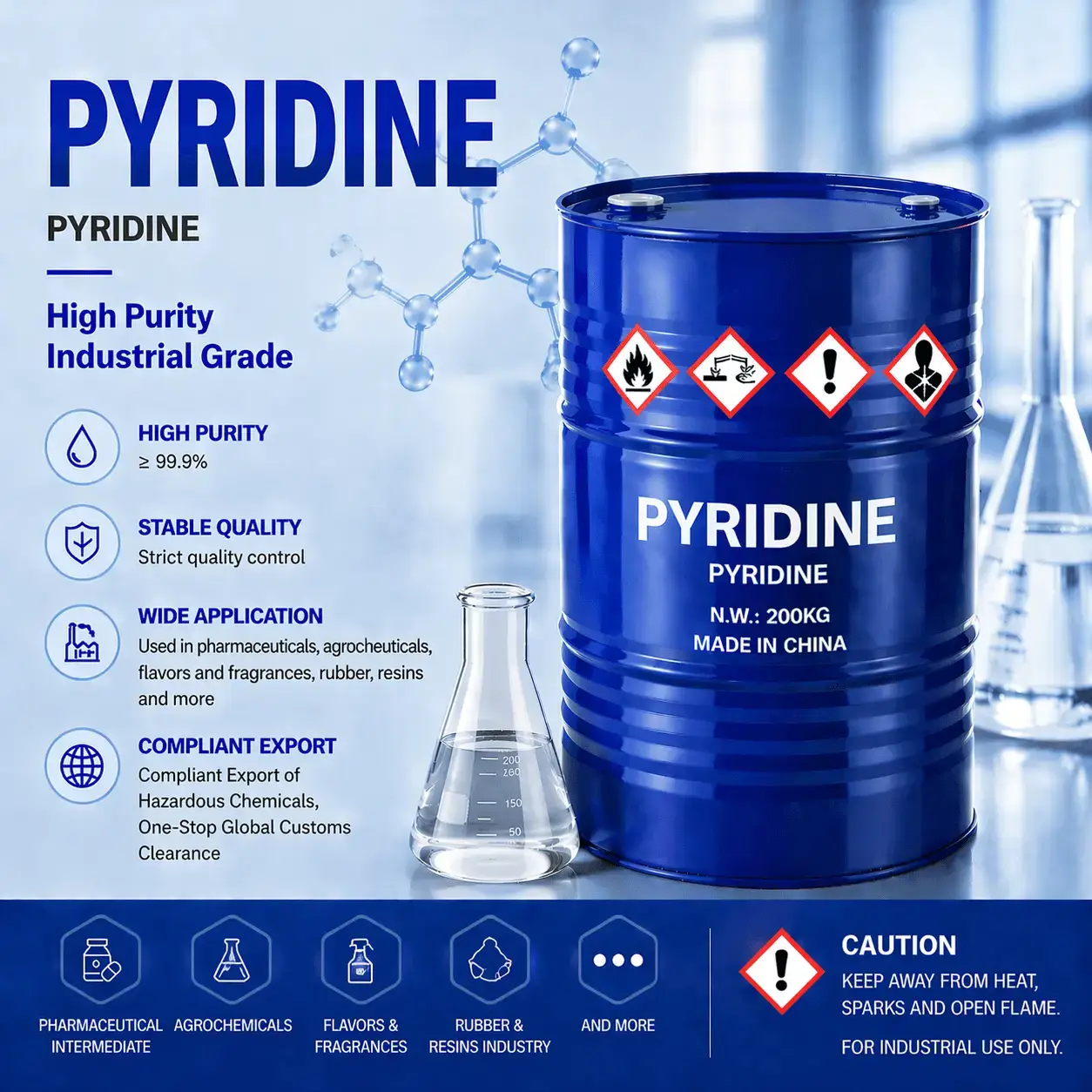
Pyridine is an important organic chemical raw material and solvent, widely used in the pharmaceutical, pesticide, dye, and food additive industries. It is weakly basic, can form salts with acids, and can act as a ligand to form complexes with metal ions. Pyridine derivatives have extensive applications in the pharmaceutical and pesticide sectors.
For detailed information on the physical and chemical properties of Pyridine, see 【Addition information】
Main Applications
1.Pharmaceutical Industry
• Drug synthesis: As organic synthesis intermediates and basic catalysts
• Active pharmaceutical ingredients (APIs): Used in the production of various active pharmaceutical ingredients (APIs)
• Pharmaceutical excipients: As pH adjusters and solvents
• Disinfection and sterilization: Synthesis of pyridothione compounds
2.Agrochemical
• Herbicides: Synthetic pyridine herbicides (e.g., paraquat)
• Insecticides: Synthetic pyridine insecticides
• Fungicides: Synthetic pyridine derivatives with fungicidal activity
3.Dyes and Pigments
• Synthetic dyes: Used in the production of azo dyes, indigo, and others
• Pigment intermediates: Used in the production of various organic pigments
• Textile printing and dyeing: Used as dye solvents and leveling agents
4.Organic Synthesis
• Catalysts: Used as basic catalysts in organic reactions
• Ligands: Form complexes with metals to catalyze reactions
• Solvents: High-boiling-point organic solvents suitable for a variety of reactions
• Knoevenagel condensation, Suzuki coupling, etc.
5.Other Applications
• Food additives: Flavoring agents (compliant with FEMA GRAS standards)
• Electronics: Solvents in the semiconductor industry
• Rubber industry: Rubber vulcanization accelerators
• Analytical chemistry: Gas chromatography stationary phases
• Laboratory reagents: Spectroscopic analysis, titrimetric analysis, etc.
GHS Hazard Classification
| Category | Information |
| Flammable liquid | Category 2 |
| Health Hazards | Category 4 |
| Acute toxicity (dermal) | Category 4 |
| Acute toxicity (inhalation) | Category 4 |
| Skin irritation | Category 2 |
| Serious eye damage/eye irritation | Category 2A |
| STOT single exposure | Category 3 |
| STOT repeated exposure | Category 2 |
Hazard Statement
H225: Highly flammable liquid and vapor
H302: Harmful if swallowed
H312: Harmful in contact with skin
H315: Causes skin irritation
H319: Causes serious eye irritation
H332: Harmful if inhaled
H335: May cause respiratory tract irritation
H373: May cause damage to organs through prolonged or repeated exposure
Shipping Information
| Category | Information |
| UN Number | UN 1282 |
| Proper Shipping Name | PYRIDINE |
| Hazard Class | Class 3: Flammable Liquids |
| Packaging Group | II ( Medium Danger) |
| HS Code | 2933.31 |
Packaging Specifications
| Packaging Type | Specification |
| Galvanized steel drum | 200 kg per bbl |
| IBC Tote | 1000kg / IBC |
| ISO Tank | 20–25 MT per tank |
| Small Package | 500ml,1 L, 4 L, 5 L, 20 L, (customizable) |
Storage Requirements
• Storage temperature: 5°C – 30°C; avoid high temperatures
• Storage environment: Store in a cool, dry, and well-ventilated area
• Keep away from heat sources: Keep away from sources of ignition, open flames, hot surfaces, and high-temperature equipment
• Keep away from incompatible substances: Strong oxidizing agents, strong acids, food, and feed
• Store away from light: Avoid direct sunlight; store in light-resistant containers
• Ventilation requirements: Maintain good ventilation to prevent vapor buildup
Safety Precautions
• Use appropriate personal protective equipment (PPE)
• Conduct operations in a fume hood or under local exhaust ventilation
• Avoid inhaling vapors, mists, or aerosols
• Avoid contact with skin and eyes
• Use explosion-proof equipment and tools
• Empty containers may contain residues; handle with care
Disclaimer
- Carefully read and follow the latest SDS provided with the product;
- Conduct a risk assessment according to actual use and local regulations;
- Implement appropriate safety measures and comply with all applicable hazardous chemical regulations.
We assume no liability for any direct or indirect loss, damage, or injury arising from the use or handling of this product. Users bear full responsibility and risk for its use.