Product Description
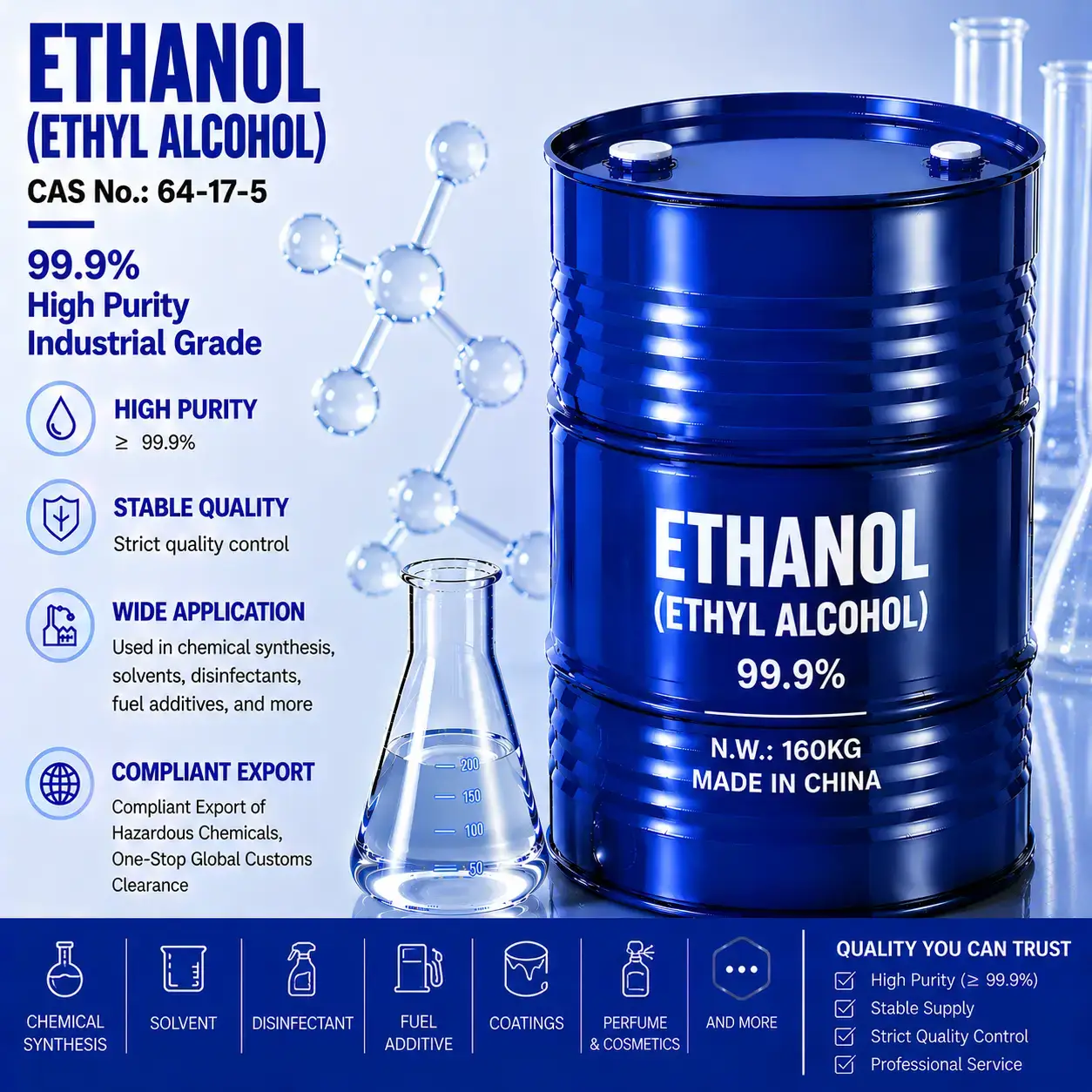
Ethanol, also known as alcohol or ethyl alcohol, is a colorless, transparent, and highly volatile liquid with a distinctive alcoholic odor. It is an important organic chemical raw material and solvent, widely used in the chemical, pharmaceutical, food, and fuel industries. Ethanol is miscible with water in any proportion and is also miscible with most organic solvents, exhibiting excellent solubility.
For detailed information on the physical and chemical properties of Ethanol, see 【Addition information】
Main Applications
1. Pharmaceuticals and Biotechnology
• Solvents for drug synthesis, extraction and purification of traditional Chinese herbal medicines, and raw materials for medical disinfection and sterilization.
2.Coatings and Inks
• Universal diluents for paints, inks, and adhesives; used to adjust viscosity and improve flow properties.
3.Electronic Cleaning
• For cleaning, degreasing, and wiping of circuit boards, precision components, and lenses; fast-drying and residue-free.
4.Personal Care & Fragrances
• Solvent for perfumes, aromatherapy products, cosmetic additives, and fragrance fixatives.
5.Organic Synthesis
• Used as an ethylating agent, reaction medium, and raw material for fine chemical intermediates.
6.General Industrial Applications
• Antifreeze, cleaning agents, extractants, and high-purity laboratory solvents.
GHS Hazard Classification
| Category | Information |
| Flammable liquids | Category 2 |
| Serious eye injury/eye irritation | Category 2A/2B |
| Germline mutagenicity | Category 1B |
| Reproductive toxicity | Category 1B |
| Specific target organ toxicity—single exposure | Category 3 |
| Acute toxicity—oral | Category 4 |
| Organ-specific toxicity—repeated exposure | Category 2 |
| Hazard statement | Danger |
Hazard Statement
H225: Highly flammable liquid and vapor
H302: Harmful if swallowed
H319 / H320: Causes serious eye irritation / Causes eye irritation
H336: May cause drowsiness or dizziness
H340: May cause genetic defects
H360: May damage fertility or the unborn child
H373: May cause damage to organs through prolonged or repeated exposure
Shipping Information
| Category | Information |
| UN Number | 1170 |
| Proper Shipping Name | Ethanol (Ethyl alcohol) |
| Hazard Class | Class 3 (Flammable Liquids) |
| Packaging Group | II |
| HS Code | 2905.11 |
Packaging Specifications
| Packaging Type | Specification |
| HDPE | 160 kg |
| IBC Tote | 1000 kg / IBC |
| ISO Tank | 20-25 MT |
| Small Package | customizable |
Storage Requirements
• Storage Conditions: Store in a cool, well-ventilated warehouse
• Temperature Control: Warehouse temperature should not exceed 30°C
• Keep Away From: Ignition sources, heat sources, oxidizers, acids, alkali metals, amines
• Safety Precautions: Use explosion-proof lighting and ventilation equipment; do not use machinery or tools that may generate sparks
• Emergency Equipment: Provide appropriate types and quantities of firefighting equipment and emergency leak response equipment
• Segregated Storage: Store separately from oxidizers, acids, alkali metals, and amines; never store together
• Grounding Measures: Storage tanks must be equipped with grounding chains; perforated partitions may be installed inside tanks to reduce static electricity generated by vibration
• Packaging Sealing: Keep containers sealed
Safety Precaution
• Respiratory protection: Generally not required; use a respirator designed for organic gases when exposed to high concentrations
• Eye protection: Chemical-resistant goggles or a full-face respirator
• Body protection: Anti-static work clothing; protective apron
• Hand protection: Nitrile rubber gloves (thickness ≥ 0.3 mm); neoprene rubber for prolonged exposure
• Other precautions: Smoking is strictly prohibited in the work area; provide safety showers and eyewash stations
Disclaimer
This product information is for reference only and does not constitute any warranty, guarantee, or legal advice. Before use, users must:
- Carefully read and follow the latest SDS provided with the product;
- Conduct a risk assessment according to actual use and local regulations;
- Implement appropriate safety measures and comply with all applicable hazardous chemical regulations.
We assume no liability for any direct or indirect loss, damage, or injury arising from the use or handling of this product. Users bear full responsibility and risk for its use.