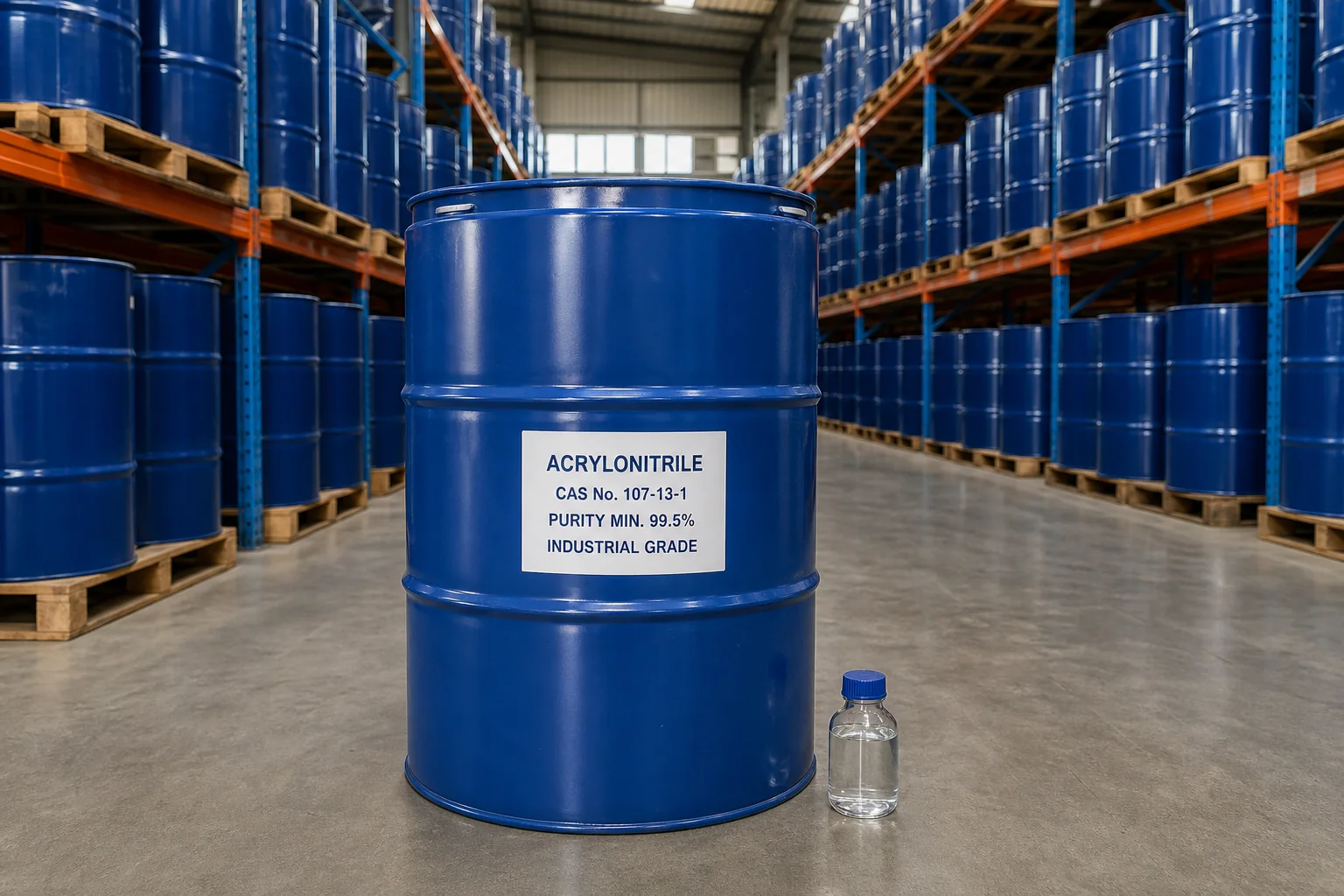
Acrylonitrile Product Details
Acrylonitrile Product Overview
Acrylonitrile, commonly abbreviated as AN, is a volatile unsaturated nitrile used mainly as a monomer and chemical intermediate. Its carbon-carbon double bond enables polymerization and copolymerization, while the nitrile group contributes chemical resistance and other performance characteristics to downstream materials. Commercial acrylonitrile is supplied as a stabilized liquid, and inhibitor-related requirements should be reviewed together with purity and impurity limits.
| Parameter | Information |
|---|---|
| Chemical name | Acrylonitrile |
| Synonyms | 2-Propenenitrile; Vinyl Cyanide; AN |
| CAS No. | 107-13-1 |
| EC No. | 203-466-5 |
| Molecular formula | C3H3N |
| Molecular weight | 53.06 g/mol |
| Typical commercial grade | Stabilized industrial monomer, purity specification ≥99.5% subject to batch COA |
| Appearance | Clear, colorless to pale-yellow liquid, free of visible suspended matter |
| Transport identification | UN 1093, ACRYLONITRILE, STABILIZED; confirm current SDS and route requirements |
Major Industrial Applications
- ABS and SAN resins: acrylonitrile contributes chemical resistance, rigidity and dimensional performance in engineering plastics and copolymers.
- Acrylic fiber and PAN: a principal monomer for acrylic textile fibers and polyacrylonitrile-based precursor materials.
- Nitrile rubber: a key feedstock for NBR used in oil-resistant hoses, seals, gaskets, gloves and adhesives.
- Acrylamide: an important intermediate route supporting polyacrylamide applications in water treatment, paper, mining and other industries.
- Other intermediates: used in selected routes to adiponitrile and specialty nitrile derivatives.
Quality Parameters Buyers Should Review
Purity is important, but it is not the only meaningful acceptance criterion. Depending on the downstream process, buyers may need to review color, water, acidity, aldehydes, acetonitrile, acetone, hydrogen cyanide, iron, copper, non-volatile residue and other trace impurities. Commercial stabilized material also includes an inhibitor system, commonly MEHQ within a controlled range. Exact limits and analytical methods should be confirmed on the supplier specification and batch COA.
- Confirm the minimum acrylonitrile assay and the test basis.
- Review water and process-sensitive impurity limits.
- Confirm inhibitor identity and acceptable range.
- Check appearance, color and suspended-matter requirements.
- Request a recent COA and agree on critical analytical methods.
Stabilization, Packaging and Storage Review
Acrylonitrile can polymerize if stabilization and handling conditions are not properly maintained. Buyers should not treat the inhibitor as an optional marketing detail. The required inhibitor range, package compatibility, storage controls and planned transit time should be reviewed before shipment. Packaging availability depends on order quantity, supplier capability, route and applicable dangerous-goods regulations; therefore, drum, ISO tank or other arrangements must be confirmed in the quotation.
Store and handle only in suitable closed systems under controls defined by the current SDS and site risk assessment. Keep away from heat, ignition sources and incompatible materials. Trained personnel, appropriate ventilation, grounding and emergency procedures are required. Do not rely on this page as a substitute for the current SDS.
Health and Regulatory Note
Acrylonitrile presents serious flammability and toxicity hazards. In 2024, the International Agency for Research on Cancer evaluated acrylonitrile as carcinogenic to humans (Group 1). This classification describes carcinogenic hazard and does not replace workplace exposure assessment, local regulatory requirements or supplier SDS instructions.
Documents and Quotation Information
For an efficient commercial review, provide the target grade, critical impurity limits, inhibitor requirements, annual or trial quantity, destination country or port, packaging preference and required documents. Xinchen can coordinate batch COA review, SDS/TDS supply, packaging confirmation and dangerous-goods export feasibility assessment for qualified inquiries.
Request an Acrylonitrile quotation or email xinchenchemical@zohomail.cn.
Frequently Asked Questions
Why is commercial acrylonitrile stabilized?
Stabilization helps control unwanted polymerization during compliant storage and transport. The inhibitor range should be checked on the applicable specification and COA.
Is purity alone enough for supplier comparison?
No. Water, inhibitor, color, acidity and trace impurities may influence polymerization or downstream quality. Compare complete specifications using aligned test methods.
What should be included in an international inquiry?
Include grade, purity, inhibitor requirement, quantity, destination, packaging, unloading capability and the required SDS, COA, TDS and shipping documents.
Safety note: This page provides general B2B product information. Only trained personnel should handle acrylonitrile in accordance with the current SDS, site controls and applicable regulations.
Document note: Classification, inhibitor control, packaging, storage and transport requirements must be confirmed against the current SDS, batch specification and destination regulations.
Technical articles and buyer guidance
- Acrylonitrile Supplier China CAS 107-13-1 FAQ: Uses, Quality Checks and Documents
- Acrylonitrile Supplier China CAS 107-13-1 Storage, Handling and Packaging Notes
- Acrylonitrile Supplier China CAS 107-13-1 Compared With Related Industrial Chemicals
- Acrylonitrile Supplier China CAS 107-13-1 Quality Factors, Purity and Performance Notes
- Acrylonitrile Supplier China CAS 107-13-1 Applications and Industrial Use Cases
- Acrylonitrile COA Review: Purity, Water, Inhibitor and Trace Impurities