Product Description
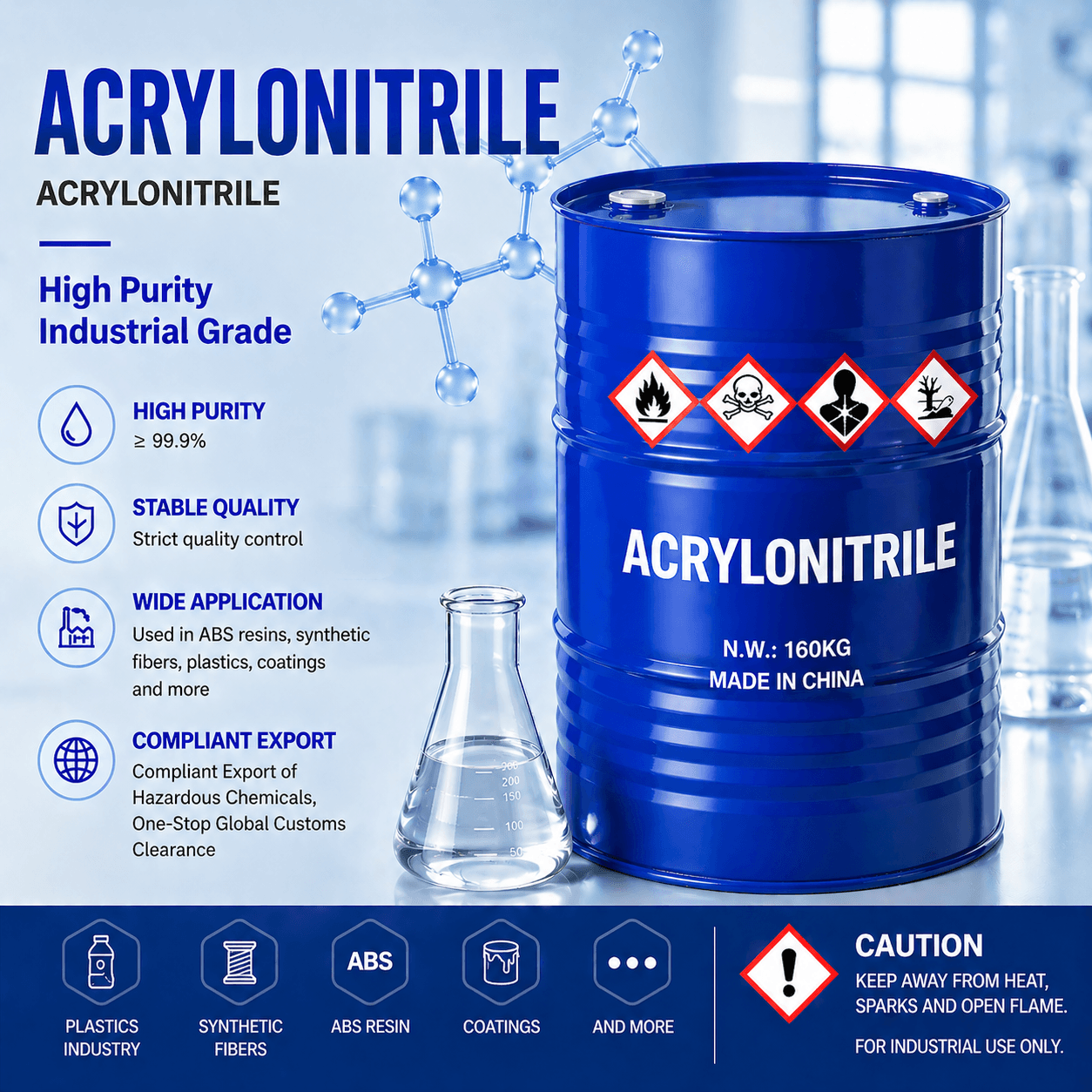
Acrylonitrile (C₃H₃N) is an important organic chemical raw material and a key synthetic monomer. It is a colorless to pale yellow volatile liquid with a distinctive pungent odor. Its molecular structure consists of a vinyl group directly bonded to a cyano group, endowing it with excellent reactivity and polymerization properties.
As a key polymerization monomer, acrylonitrile is widely used in the production of high-performance polymers such as polyacrylonitrile (PAN), ABS resin, SAN resin, and nitrile rubber (NBR). It is also an important raw material for fine chemical products such as acrylamide, acrylic esters, and adiponitrile.
Acrylonitrile is flammable and prone to self-polymerization when exposed to heat, light, or contact with strong alkalis and peroxides. This substance is toxic and has been classified by the IARC as a Group 1 potential carcinogen; strict safety protocols must be followed during production, storage, transportation, and use.
For detailed information on the physical and chemical properties of Acrylonitrile,see 【Addition information】
Main Applications
1.Synthetic Fibers
• Polyacrylonitrile (PAN) fibers (acrylic fibers): Good warmth retention, elasticity and weather resistance, widely used in clothing, home textiles, industrial filter materials, etc.
2.Engineering plastics
• ABS resin (acrylonitrile-butadiene-styrene copolymer): Offers excellent overall performance and is used in automotive parts, appliance housings, electronic products, toys, and more.
• SAN resin (styrene-acrylonitrile copolymer): Features good chemical resistance and transparency.
3.Synthetic rubber
• Nitrile rubber (NBR): With excellent oil resistance and abrasion resistance, it is widely used in oil seals, hoses, gaskets, printing rollers, and other applications.
4.Chemical intermediate
• Acrylamide: Used in water treatment, papermaking, oil extraction, and other applications.
• Methyl methacrylate: Used in acrylic glass, coatings, and adhesives.
• Adiponitrile: A key raw material for nylon 66.
5.Carbon fiber precursor
• PAN-based carbon fiber: A high-performance material used in aerospace, wind turbine blades, sports equipment, and other fields.
6.Other Applications
• Pesticide intermediates, pharmaceutical intermediates, soil fumigants, ion exchange resins, flocculants, etc.
GHS Hazard Classification
| Category | Information |
| Flammable liquid | Category 2 |
| Acute toxicity (oral/dermal/inhalation) | Category 3 |
| Skin corrosion/irritation | Category 2 |
| Serious eye injury/eye irritation | Category 1 |
| Skin allergens | Category 1 |
| Carcinogenicity | Category 1B |
| Specific target organ toxicity—single exposure | Category 3 |
| Harmful to the aquatic environment—long-term hazard | Category 2 |
Hazard Statement
H225: Highly flammable liquid and vapor
H301: Toxic if swallowed
H311: Toxic in contact with skin
H331: Toxic if inhaled
H315: Causes skin irritation
H318: Causes serious eye damage
H317: May cause an allergic skin reaction
H350: May cause cancer
H335: May cause respiratory irritation
H411: Toxic to aquatic life with long-lasting effects
Shipping Information
| Category | Information |
| UN Number | UN 1093 |
| Proper Shipping Name | ACRYLONITRILE, STABILIZED |
| Hazard Class | Class 3: Flammable Liquids |
| Packaging Group | I (High Risk) |
| HS Code | 2933.31 |
Packaging Specifications
| Packaging Type | Specification |
| Galvanized steel drum | 200 kg per bbl |
| IBC Tote | 1000kg / IBC |
| ISO Tank | 20–25 MT per tank |
| Small Package | customizable |
Storage Requirements
• Temperature Requirements: 2–8°C (refrigerated storage); Store in a cool, dry place
• Light Requirements: Store away from light; Avoid direct sunlight
• Ventilation Requirements: Store in a sealed container; Keep container tightly closed; Store in a well-ventilated area
• Safety Equipment: Safety Equipment Use explosion-proof electrical equipment | Use non-sparking tools | Ensure grounding and static dissipation
• Fire Protection: Fire Protection Fire-resistant building | Provide firefighting equipment | Emergency showers and eye wash stations
• Segregation: Segregation Store separately from strong oxidizers, strong alkalis, acids, food, and feed
Safety Precautions
• Use appropriate personal protective equipment (PPE)
• Conduct operations in a fume hood or under local exhaust ventilation
• Avoid inhaling vapors, mists, or aerosols
• Avoid contact with skin and eyes
• Use explosion-proof equipment and tools
• Empty containers may contain residues; handle with care
Disclaimer
This product information is for reference only and does not constitute any warranty, guarantee, or legal advice. Before using DMF, users must:
- Carefully read and follow the latest SDS provided with the product;
- Conduct a risk assessment according to actual use and local regulations;
- Implement appropriate safety measures and comply with all applicable hazardous chemical regulations.
We assume no liability for any direct or indirect loss, damage, or injury arising from the use or handling of this product. Users bear full responsibility and risk for its use.