Product Description
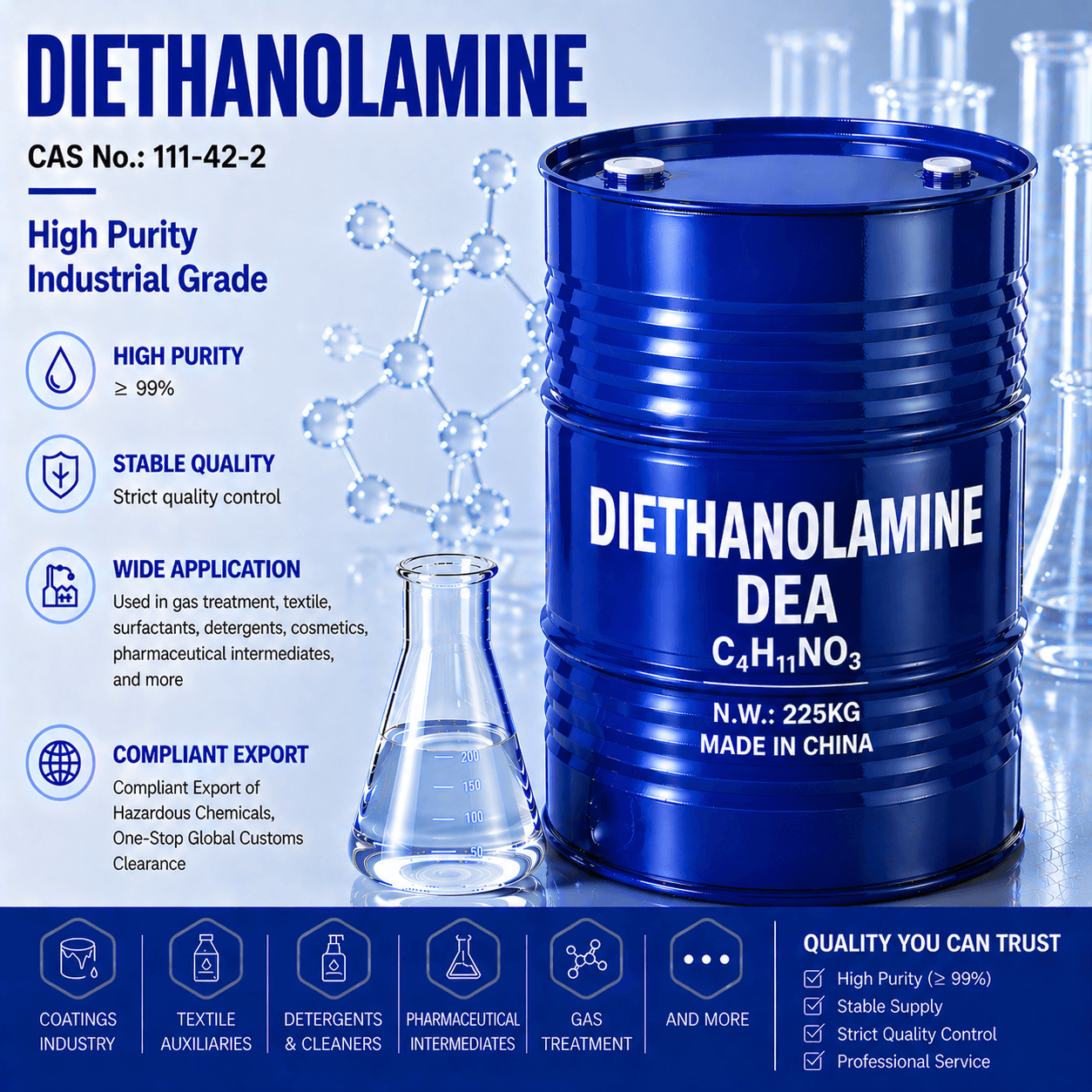
Diethanolamine (DEA) is an important organic compound belonging to the ethanolamine class of chemicals. It is a colorless, viscous liquid or crystalline solid with a faint ammonia-like odor. DEA combines the chemical properties of a secondary amine and an alcohol, exhibiting unique dual reactivity. As an amine, it is weakly basic and can react with acids to form salts; as an alcohol, it is hygroscopic and can form esters.
DEA is widely used in various industrial fields, including gas purification, surfactant synthesis, personal care products, textile processing, and pesticide manufacturing. It is a key intermediate in the production of glyphosate herbicides and a major component of acid gas absorbers for carbon dioxide, hydrogen sulfide, and other acidic gases.
For detailed information on the physical and chemical properties of DEA, see 【Addition information】
Main Applications
1. Gas Purification and Desulfurization
• Used in natural gas, oil refineries, and coal chemical plants to remove hydrogen sulfide and carbon dioxide, with high desulfurization efficiency.
2.Surfactants
• Synthesizes nonionic surfactants such as coconut oil diethyleneglycolamide, used in detergent, personal care, and emulsifier formulations.
3. Textile and Leather Industries
• Used as textile leveling agents, softeners, and pH adjusters; leather tanning agents, degreasing agents, and raw materials for auxiliaries.
4.Water Treatment Industry
• Used as corrosion inhibitors, scale inhibitors, and neutralizing agents to ensure corrosion protection and stability in industrial circulating water systems.
5.Rubber and Coatings
• Rubber vulcanization accelerators, neutralizing agents for coating resins, curing agents, and solvent intermediates.
6.Organic Synthesis
• Used in the synthesis of intermediates for pharmaceuticals, pesticides, and fine chemicals, with a wide range of applications.
GHS Hazard Classification
| Category | Information |
| Acute toxicity—oral | Category 4 |
| Skin corrosion/irritation | Category 1B |
| Serious eye injury/eye irritation | Category 1 |
| Skin sensitization | Category 1B |
| Reproductive toxicity | Category 1B |
| Organ-specific toxicity—repeated exposure | Category 2 |
| Hazards to the aquatic environment—chronic toxicity | Category 3 |
| Hazard statement | Danger |
Hazard Statement
H302: Harmful if swallowed
H314: Causes severe skin burns and eye damage
H315: Causes skin irritation
H317: May cause an allergic skin reaction
H318: Causes serious eye damage
H360Df: May cause harm to the unborn child. Suspected of damaging fertility
H373: Long-term or repeated exposure may cause damage to organs (liver, kidneys)
H412: Harmful to aquatic life with long-lasting effects
Shipping Information
| Category | Information |
| UN Number | 3267 |
| Proper Shipping Name | Corrosive liquid, basic, organic, n.o.s. |
| Hazard Class | Class 8 (Corrosive substances) |
| Packaging Group | Ⅱ |
| HS Code | 2922.12 |
Packaging Specifications
| Packaging Type | Specification |
| Galvanized steel drum | 225 kg |
| IBC Tote | 1000 kg / IBC |
| ISO Tank | 18-20 MT |
| Small Package | customizable |
Storage Requirements
• Store in a cool, well-ventilated warehouse, away from sources of ignition and heat.
• Packaging must be sealed to prevent moisture absorption and reaction with CO₂ in the air.
• Store separately from oxidizers, acids, and other incompatible substances; never store together.
• Provide appropriate types and quantities of firefighting equipment.
• The storage area should be equipped with emergency spill response equipment and suitable containment materials.
• Long-term storage may cause the product to fade.
Safety Precaution
• Respiratory protection: Use in a well-ventilated area; wear appropriate respiratory protection when necessary
• Hand protection: Wear chemical-resistant gloves (e.g., nitrile or neoprene)
• Eye protection: Wear safety goggles or a face shield
• Body protection: Wear acid- and alkali-resistant protective clothing
• The workplace should be equipped with an eyewash station and safety shower facilities
Disclaimer
This product information is for reference only and does not constitute any warranty, guarantee, or legal advice. Before using DMF, users must:
- Carefully read and follow the latest SDS provided with the product;
- Conduct a risk assessment according to actual use and local regulations;
- Implement appropriate safety measures and comply with all applicable hazardous chemical regulations.
We assume no liability for any direct or indirect loss, damage, or injury arising from the use or handling of this product. Users bear full responsibility and risk for its use.