Product Description
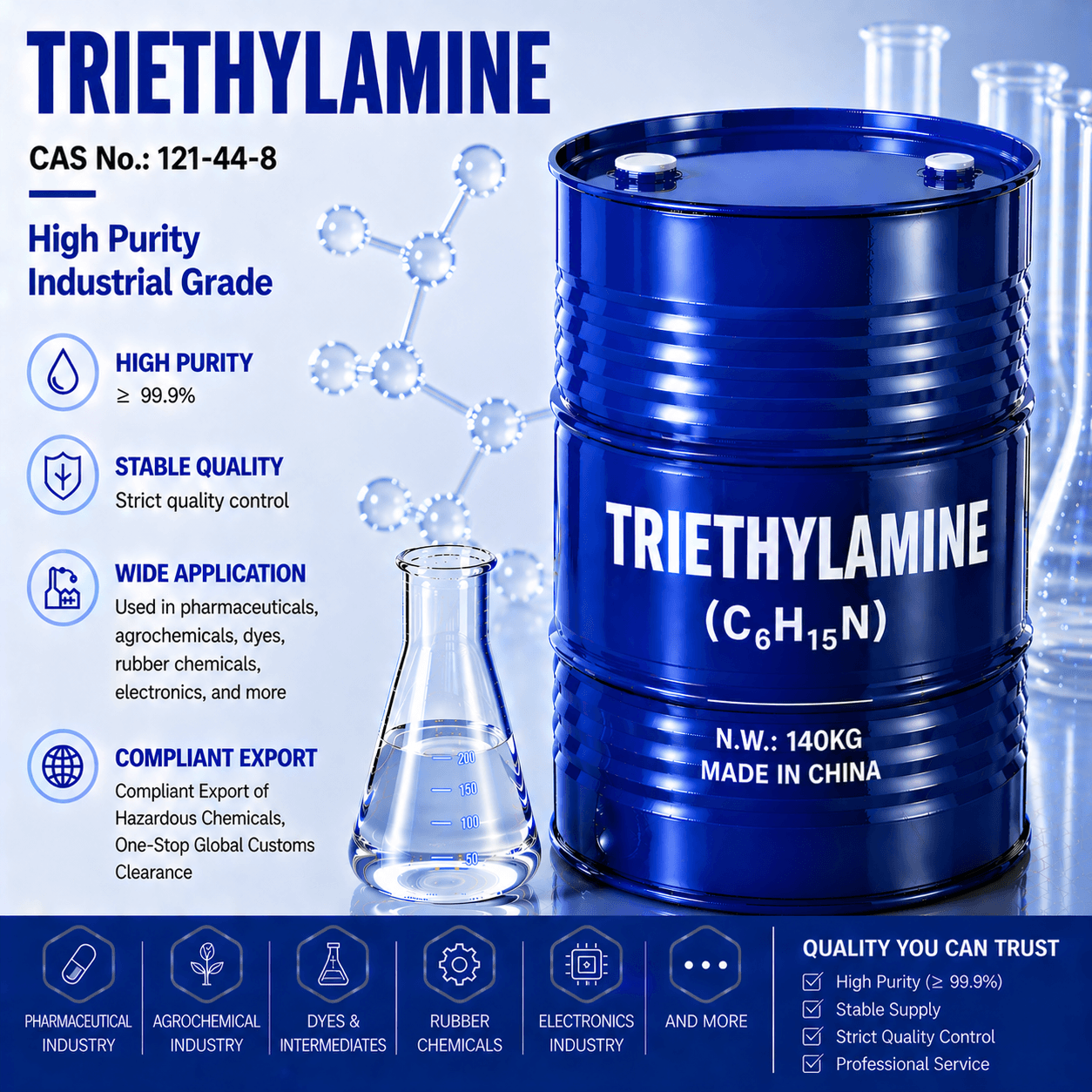
Triethylamine (TEA) is a colorless to pale yellow transparent liquid with a strong ammonia-like odor. It is a tertiary amine compound formed by replacing three hydrogen atoms in an ammonia molecule with ethyl groups. It is primarily used as a chelating agent, catalyst, emulsifier, and solvent. Triethylamine is highly soluble and miscible with organic solvents such as alcohols, ethers, esters, and aromatics. It is widely used in the pharmaceutical, pesticide, coatings, resin, rubber, and fine chemical synthesis industries.
For detailed information on the physical and chemical properties of TEA, see 【Addition information】
Main Applications
1. Organic Synthesis
• Triethylamine is a commonly used organic base catalyst and acid-capturing agent, widely employed as a deacidifying agent in organic synthesis reactions such as esterification, etherification, and amidation.
2.Pharmaceutical Synthesis
• In pharmaceutical synthesis, it serves as a basic catalyst and intermediate, playing a role in the synthesis of various active pharmaceutical ingredients.
3.Pesticide Intermediates
• It is a key intermediate in the production of various pesticide products, used in the synthesis of herbicides, insecticides, and others.
4.Dyes and Pigments
• It is used as a catalyst and acid-binding agent in the synthesis of dyes and pigments.
5.Surfactants
• It is used in the production of quaternary ammonium cationic surfactants.
6.Electronic Chemicals
• Used in photoresist development, cleaning, and other processes in the electronics industry.
7.Chromatographic Analysis
• Used as a mobile phase additive or modifier in gas chromatography and liquid chromatography.
8.Rubber Processing
• Used as a catalyst for rubber vulcanization.
9.Food Additives
• FEMA No. 4246, JECFA No. 1611; may be used as a food flavoring agent (in accordance with relevant regulations).
GHS Hazard Classification
| Category | Information |
| Flammable liquids | Category 2 |
| Acute toxicity—oral | Category 4 |
| Acute toxicity—dermal | Category 3 |
| Acute toxicity—inhalation (vapors) | Category 3/4 |
| Skin corrosion/irritation | Category 1/1A |
| Serious eye injury/eye irritation | Category 1 |
| Specific target organ toxicity—single exposure | Category 3 |
| Hazards to the aquatic environment—acute toxicity | Category 2/3 |
| Hazard statement | Danger |
Hazard Statement
H225: Highly flammable liquid and vapor
H302: Harmful if swallowed
H311: Toxic in contact with skin
H314: Causes severe skin burns and eye damage
H318: Causes serious eye damage
H331: Toxic if inhaled
H332: Harmful if inhaled
H335: May cause respiratory irritation
H401/H402: Toxic/Harmful to aquatic life
Shipping Information
| Category | Information |
| UN Number | 1296 |
| Proper Shipping Name | Triethylamine |
| Hazard Class | Class 3 (Flammable Liquids) |
| Packaging Group | II |
| HS Code | 2921.23 |
Packaging Specifications
| Packaging Type | Specification |
| Galvanized steel drum | 140 kg |
| IBC Tote | 800-1000 kg / IBC |
| ISO Tank | 15-20 MT |
| Small Package | 100 mL, 500 mL, 1 L, 2 L(Customization) |
Storage Requirements
• Store in a cool, dry, well-ventilated warehouse, away from sources of fire and heat.
• The recommended storage temperature is below 30°C; avoid direct sunlight.
• Keep containers tightly sealed to prevent vapors from escaping into the workplace air.
• Store separately from oxidizers, strong acids, ketones, aldehydes, halogenated hydrocarbons, and other incompatible substances; never store together.
• Use explosion-proof electrical equipment, lighting, and ventilation systems.
• Provide appropriate types and quantities of firefighting equipment and emergency spill response equipment.
Safety Precaution
• Respiratory protection: Wear appropriate respiratory protection, such as a gas mask (with ABEK-type filters, compliant with EN 14387)
• Eye protection: Wear splash-proof safety goggles or a face shield
• Hand protection: Wear chemical-resistant gloves (such as nitrile rubber gloves)
• Body protection: Wear antistatic work clothing and other protective gear
Disclaimer
This product information is for reference only and does not constitute any warranty, guarantee, or legal advice. Before using DMF, users must:
- Carefully read and follow the latest SDS provided with the product;
- Conduct a risk assessment according to actual use and local regulations;
- Implement appropriate safety measures and comply with all applicable hazardous chemical regulations.
We assume no liability for any direct or indirect loss, damage, or injury arising from the use or handling of this product. Users bear full responsibility and risk for its use.