Product Description
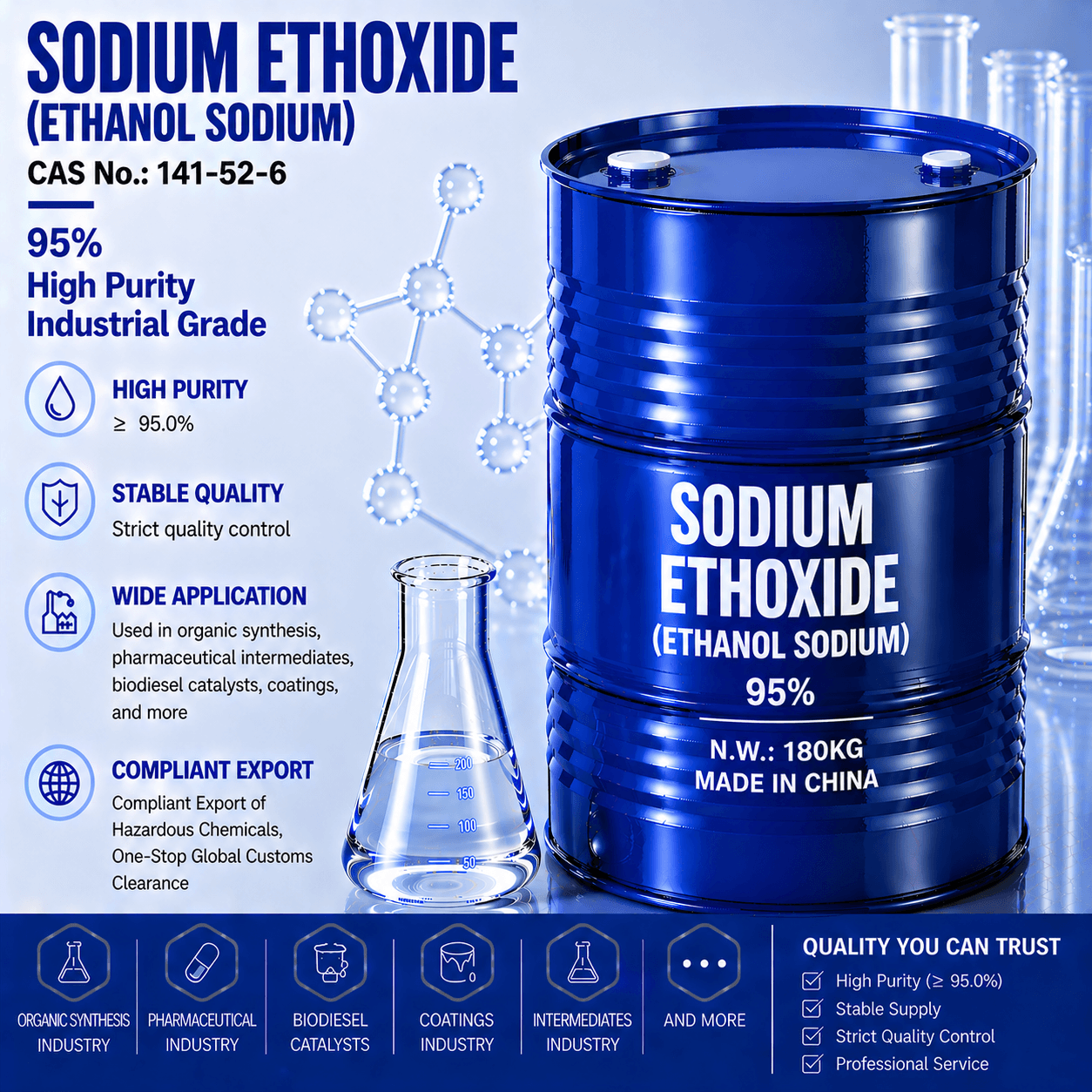
Sodium ethoxide, also known as sodium ethylate or sodium ethoxide salt, is an important organic compound and a strong alkaline reagent. Sodium ethoxide is highly soluble in ethanol and methanol, and reacts violently with water to form sodium hydroxide and ethanol. It is a strong base that absorbs carbon dioxide from the air and gradually decomposes. As a highly reactive strong base, it is widely used as a catalyst, ethoxylating agent, condensing agent, and reducing agent, and is suitable for organic synthesis in anhydrous systems. It serves as a key raw material in the pharmaceutical, pesticide, fragrance, dye, and fine chemical industries.
For detailed information on the physical and chemical properties of Sodium ethoxide, see 【Addition information】
Main Applications
1. Pharmaceutical Synthesis
• Strong base catalyst/condensing agent for the synthesis of drugs such as phenobarbital, phenylbutazone, primidone, methyldopa, and ethambutol.
2.Pesticide Industry
• Used as an ethoxylating agent and base catalyst in the synthesis of intermediates for herbicides and insecticides.
3.Fine Chemicals Synthesis
•Strong base catalyst / initiator for reactions such as Claisen condensation, ester exchange, anionic polymerization, and ring-opening polymerization.
4.Fragrances and Dyes
• Used in the etherification of fragrances and the condensation of dye intermediates to improve reaction yield and purity.
5.Analytical Reagents
• Strong base standard solution for non-aqueous titration and the determination of organic functional groups.
GHS Hazard Classification
| Category | Information |
| Self-heating substance | Category 1 |
| Skin corrosion/irritation | Category 1B |
| Serious eye injury/eye irritation | Category 1 |
| Specific target organ toxicity—single exposure | Category 2 |
| Hazards to the aquatic environment—chronic toxicity | Category 2 |
| Hazard statement | Danger |
Hazard Statement
H251: Self-heating; may cause fire
H314: Causes severe skin burns and eye damage
H318: Causes serious eye damage
H371: May cause damage to organs
H411: Toxic to aquatic life with long-lasting effects
Shipping Information
| Category | Information |
| UN Number | 3206 |
| Proper Shipping Name | ALKALI METAL ALCOHOLATES, SELF-HEATING, CORROSIVE, N.O.S |
| Hazard Class | Class 4.2 (Self-reactive substances) Class 8 (Corrosives) |
| Packaging Group | II |
| HS Code | 2905.19 |
Packaging Specifications
| Packaging Type | Specification |
| Galvanized steel drum | 80kg(solid), 180kg(liquid), |
| IBC Tote | — |
| ISO Tank | — |
| Small Package | Customization |
Storage Requirements
• Keep the container tightly closed and store in a dry, well-ventilated area
• Store at a temperature of ≤20°C and avoid direct sunlight
• Use an inert gas (nitrogen or argon) for protection
• Keep away from sources of fire, heat, and oxidizing agents
• Leave space between stacks/pallets to allow for heat dissipation
Safety Precaution
• Eye protection: Wear safety goggles or a face shield (e.g., compliant with EN 166)
• Skin protection: Wear chemical-resistant gloves, an apron, and protective clothing
• Respiratory protection: Use an appropriate respirator (e.g., NIOSH-approved or compliant with EN 149)
Disclaimer
This product information is for reference only and does not constitute any warranty, guarantee, or legal advice. Before using DMF, users must:
- Carefully read and follow the latest SDS provided with the product;
- Conduct a risk assessment according to actual use and local regulations;
- Implement appropriate safety measures and comply with all applicable hazardous chemical regulations.
We assume no liability for any direct or indirect loss, damage, or injury arising from the use or handling of this product. Users bear full responsibility and risk for its use.