Sodium Ethoxide Product Overview
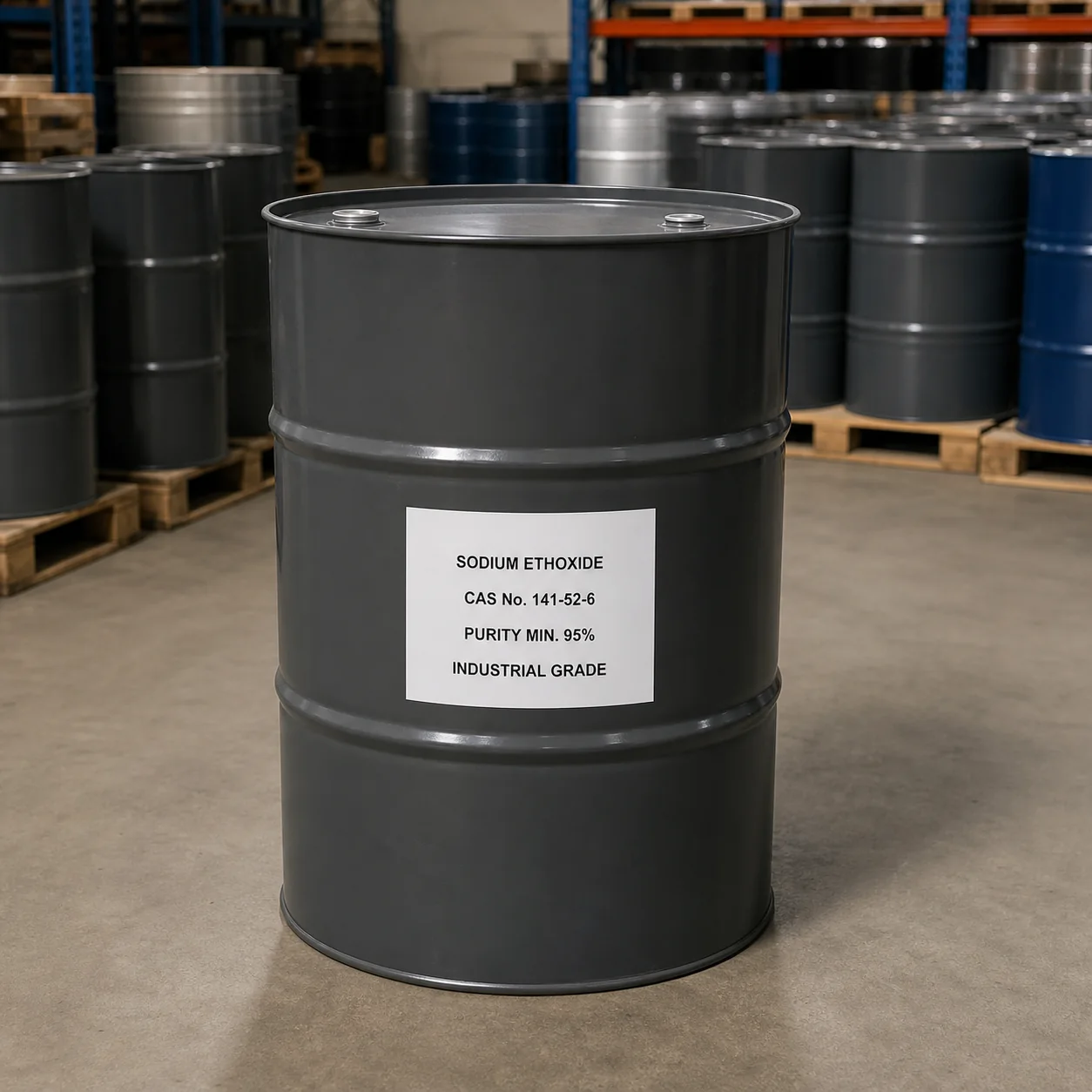
Sodium Ethoxide, also called Sodium Ethylate or Sodium Ethanolate, is a strong alkoxide base and nucleophilic reagent used in anhydrous organic synthesis. It is commercially available as a hygroscopic solid and as a ready-to-use solution in ethanol. These forms are not interchangeable in every process: concentration, solvent load, water sensitivity, dosing method and logistics should be reviewed before selection.
| Parameter | Information |
|---|
| Chemical name | Sodium Ethoxide |
| Synonyms | Sodium Ethylate; Sodium Ethanolate |
| CAS No. | 141-52-6 |
| EC No. | 205-487-5 |
| Molecular formula | C2H5ONa |
| Molecular weight | 68.05 g/mol |
| Commercial forms | Solid, typical assay ≥95%; 21% solution in ethanol |
| Typical appearance | Solid: pale or white hygroscopic material; solution: yellowish to brown liquid |
Solid or 21% Ethanol Solution?
The solid grade provides a higher active-material concentration and may suit processes that can safely charge and dissolve a moisture-sensitive solid. The 21% ethanol solution provides a pumpable, ready-to-use form and can simplify controlled dosing where ethanol is compatible with the process. Buyers should evaluate reactor configuration, acceptable solvent contribution, concentration tolerance and moisture control rather than selecting solely by headline assay.
Typical Industrial Applications
- Organic synthesis: deprotonation and alkoxide-mediated reactions in fine-chemical and intermediate production.
- Transesterification and condensation: catalyst or strong-base reagent in selected ester and carbon-carbon bond-forming processes.
- Polymer chemistry: initiator or catalyst in selected ring-opening and anionic polymerization systems.
- Pharmaceutical and specialty intermediates: process reagent where controlled alkalinity and low water content are required.
COA and Specification Review
A useful comparison should identify the product form and analytical basis. For solid Sodium Ethoxide, review assay, free alkali, carbonate and moisture-related limits. For the solution, review effective Sodium Ethoxide concentration, solvent identity, sodium hydroxide plus sodium carbonate, appearance and any process-specific impurity limits. Request a recent batch COA and confirm that competing quotations use comparable test methods.
- Confirm solid assay or solution concentration and tolerance.
- Review sodium hydroxide and sodium carbonate limits.
- Confirm ethanol quality and water-sensitive requirements for solution grades.
- Agree on appearance, test methods and batch acceptance criteria.
Packaging, Storage and Transport
Sodium Ethoxide reacts readily with moisture, and package integrity is therefore a central quality consideration. The selected container, closure, fill quantity and handling arrangement must match the solid or solution grade. Keep containers tightly closed and protect them from moisture, heat and incompatible materials according to the current SDS and site procedures.
Transport classification can differ by formulation and concentration. A universal UN number or hazard class should not be applied to both solid material and ethanol solution without verification. Xinchen confirms the exact product form, packaging availability and applicable shipping description during quotation review.
Documents and Quotation Information
For a precise quotation, provide the required form, assay or solution concentration, quantity, destination country or port, packaging preference, application and critical impurity limits. Batch COA, SDS, TDS and available export documentation can then be reviewed against the selected grade.
Request a Sodium Ethoxide quotation or email xinchenchemical@zohomail.cn.
Frequently Asked Questions
Are solid Sodium Ethoxide and 21% solution the same commercial grade?
No. They contain the same active chemical but differ substantially in concentration, physical form, solvent contribution, dosing and logistics.
What should buyers compare on a COA?
Compare active content, free alkali and carbonate limits, moisture or solvent-related values, appearance and the analytical methods used.
Can one transport classification be used for every Sodium Ethoxide product?
No. Classification depends on physical form, concentration and formulation. Confirm the current SDS and shipping description for the exact supplied grade.
Safety note: This page provides general B2B product information. Sodium Ethoxide is moisture-sensitive and corrosive; trained personnel must follow the current SDS, site controls and applicable regulations.