n-Hexane Product Overview
n-Hexane is a straight-chain C6 hydrocarbon used as a low-boiling, fast-evaporating solvent. It has useful solvency for many oils, fats, rubber compounds and hydrocarbon materials, but its occupational-health and regulatory profile requires careful review. Pure n-Hexane should also be distinguished from commercial “hexane” or extraction-solvent mixtures that may contain several C6 hydrocarbons.
| Parameter | Information |
|---|
| Chemical name | n-Hexane |
| Synonyms | Normal Hexane; Hexyl Hydride |
| CAS No. | 110-54-3 |
| EC No. | 203-777-6 |
| Molecular formula | C6H14 |
| Molecular weight | 86.18 g/mol |
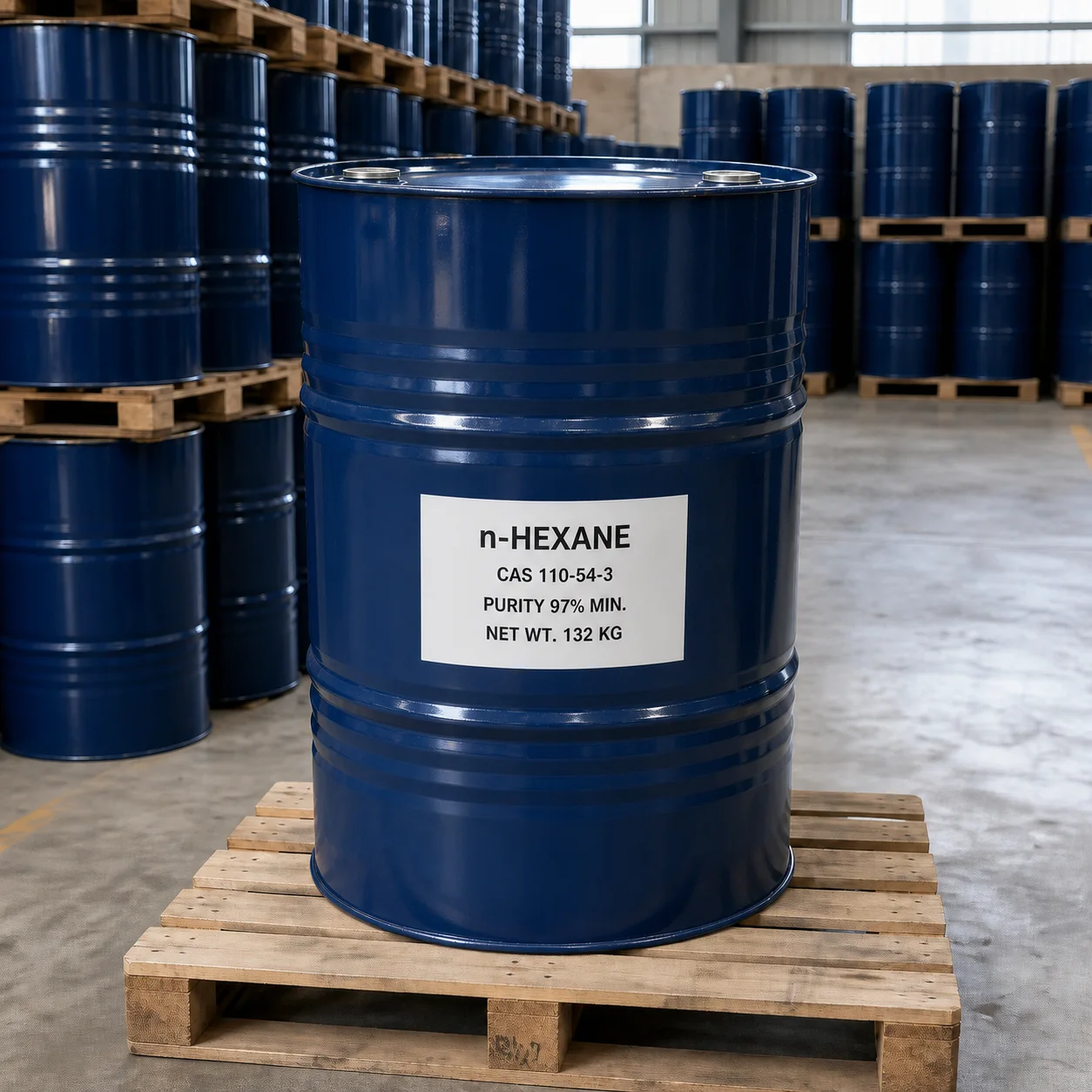
| Typical industrial specification | n-Hexane ≥97%, subject to supplier specification and batch COA |
| Appearance | Clear, colorless, highly volatile liquid with a gasoline-like odor |
| Transport identification | UN 1208, HEXANES; confirm the exact composition, current SDS and route requirements |
n-Hexane vs Commercial Hexane Mixtures
The word “hexane” is sometimes used for refinery streams containing n-Hexane together with methylpentanes, dimethylbutanes, cyclohexane or other light hydrocarbons. CAS 110-54-3 identifies n-Hexane specifically. Buyers should request a composition profile and confirm whether a quotation is for high-n-Hexane material or a mixed commercial solvent. These products may differ in solvency, boiling range, exposure profile and regulatory treatment.
Typical Industrial Applications
- Extraction: solvent in selected oil, fat and natural-product extraction processes where the exact grade is approved.
- Rubber and adhesives: process solvent for compatible rubber compounds, cements and adhesive systems.
- Chemical processing: reaction, crystallization or carrier solvent where low polarity and rapid evaporation are useful.
- Cleaning and degreasing: limited industrial use in controlled systems; exposure, emissions and safer-substitution requirements must be evaluated.
COA and Composition Review
For high-purity n-Hexane, compare the actual n-Hexane assay rather than total C6 hydrocarbons alone. Depending on the application and market, buyers may also need a component profile, initial and final boiling points, density, color, water, sulfur, benzene and non-volatile residue. Analytical methods should be aligned before supplier comparison.
Health and EU Regulatory Review
Repeated n-Hexane exposure can damage the peripheral nervous system. NIOSH identifies peripheral neuropathy among its principal health effects and recommends occupational exposure controls. On 4 February 2026, ECHA added n-Hexane to the REACH Candidate List of substances of very high concern because of neurotoxic properties associated with repeated exposure. EU buyers should assess current REACH duties, substitution expectations and downstream communication requirements with qualified regulatory personnel.
Packaging, Storage and Transport
n-Hexane is highly flammable and very volatile. Package and bulk-supply options must match quantity, composition, destination and dangerous-goods requirements. Store in tightly closed compatible containers away from heat, ignition sources, oxidizers and uncontrolled emissions. Grounding, ventilation, vapor control and worker-protection measures must follow the current SDS and site risk assessment.
Documents and Quotation Information
Provide the required n-Hexane assay, composition or boiling-range limits, application, quantity, destination, packaging and documentation requirements. Xinchen can coordinate specification, recent batch COA, SDS/TDS and export-feasibility review.
Request an n-Hexane quotation or email xinchenchemical@zohomail.cn.
Frequently Asked Questions
Does every “hexane” solvent have CAS 110-54-3?
No. Commercial hexane mixtures may contain several C6 hydrocarbons. Confirm the CAS identity and composition profile.
Which COA values matter for high-purity n-Hexane?
Review n-Hexane assay, component profile, distillation range, water, sulfur, benzene, color and residue according to the application.
Is n-Hexane on the EU REACH Candidate List?
Yes. ECHA added it on 4 February 2026 because of neurotoxic properties associated with repeated exposure.
Safety note: n-Hexane is highly flammable and can cause neurological harm after repeated exposure. This page does not replace the current SDS, occupational exposure assessment or regulatory advice.