Sodium Methoxide Product Overview
Sodium methoxide, also called sodium methylate or sodium methanolate, is an industrial alkoxide with the formula CH3ONa. It is valued as a strong base, catalyst and deprotonating reagent in processes that require low water content and consistent alkalinity. Commercial supply is generally divided into solid sodium methoxide and sodium methoxide solution in methanol. These forms are not interchangeable in every process, so the required form and concentration should be confirmed before quotation.
| Parameter | Information |
|---|
| Chemical name | Sodium Methoxide / Sodium Methylate |
| CAS No. | 124-41-4 |
| EC No. | 204-699-5 |
| Molecular formula | CH3ONa |
| Molecular weight | 54.02 g/mol |
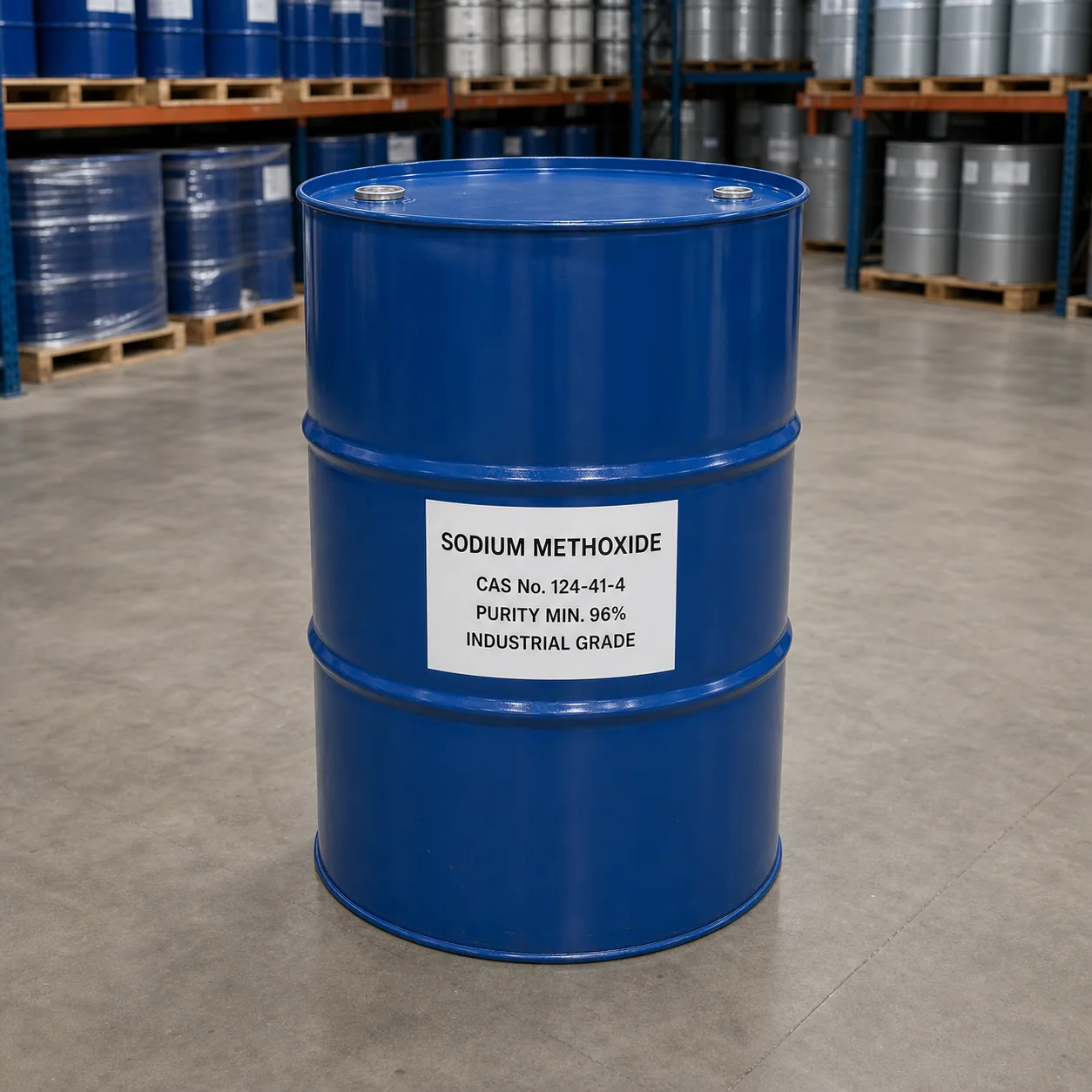
| Available forms | Solid material, typically ≥96%; solution in methanol, commonly 30% |
| Appearance | Solid: white hygroscopic powder or granules; solution: clear, colorless to slightly yellow liquid |
| Documents | Batch COA, SDS, TDS and export-related documents subject to product and destination requirements |
Solid Sodium Methoxide or 30% Solution?
Solid sodium methoxide provides a high active-content option for processes where additional methanol is undesirable or where the reagent is charged as a solid. Because it is strongly hygroscopic and reacts with moisture, the condition of the packaging and the batch moisture-related specification deserve close attention.
Sodium methoxide solution in methanol is a ready-to-use liquid form that can simplify dosing in suitable industrial systems. A 30% solution is widely used for transesterification and other catalytic processes. Buyers should confirm the assay basis, methanol content, appearance and any applicable impurity limits on the batch COA.
Typical Industrial Applications
- Biodiesel production: catalyst for the transesterification of suitable triglyceride feedstocks.
- Pharmaceutical and agrochemical synthesis: strong base or reagent in selected condensation, substitution and methylation steps.
- Fine chemicals: catalyst or reagent for methoxylation, ester-related reactions and other water-sensitive synthesis routes.
- Polymer and chemical processing: used in selected depolymerization, ether-production and specialty synthesis processes.
The suitability of a grade depends on the customer’s process, raw materials and quality requirements. Application testing and review of the current batch documents are recommended before commercial use.
Quality Points to Confirm Before Ordering
- Required form: solid or methanol solution.
- Target sodium methoxide assay or solution concentration.
- Moisture, free alkalinity and other process-sensitive limits.
- Required batch COA test items and analytical methods.
- Packaging size, liner or closure requirements and planned storage period.
- Destination-country documentation and dangerous-goods transport feasibility.
Packaging, Storage and Transport Review
Packaging must be selected according to the product form and agreed specification. Industrial suppliers commonly use moisture-protective drums for solid material, while methanol solutions may be supplied in compatible drums, IBCs or bulk systems where regulations and logistics permit. Exact package size should be confirmed in the quotation rather than assumed from a generic product table.
Keep containers tightly closed in a cool, dry and well-ventilated area. Protect the product from moisture, water, acids and incompatible materials. Sodium methoxide and its methanol solutions require trained handling and a review of the current SDS. Transport classification and packaging requirements may differ by concentration, formulation and destination, so shipment details should be verified for each order.
Documentation and Quotation Information
For an efficient quotation, provide the product form, target assay or concentration, order quantity, destination country or port, packaging preference, intended application and required documents. Xinchen can coordinate batch COA review, SDS/TDS supply, packaging confirmation and export logistics assessment for qualified orders.
Request a Sodium Methoxide quotation or email xinchenchemical@zohomail.cn.
Frequently Asked Questions
Is sodium methoxide the same as sodium methylate?
Yes. Sodium methoxide, sodium methylate and sodium methanolate are commonly used names for the substance identified by CAS 124-41-4.
Which form should be specified in an inquiry?
State whether you require solid sodium methoxide or a solution in methanol, together with the target assay or concentration. This prevents specification and packaging mismatches.
Can one COA specification be used for every application?
No. Different processes may be sensitive to moisture, free alkalinity, methanol content or other impurities. Buyers should define the critical limits for their own process and review a representative or batch-specific COA.
Safety note: This page provides general commercial information and does not replace the current SDS, customer risk assessment or applicable regulations. Only trained personnel should handle this material.