
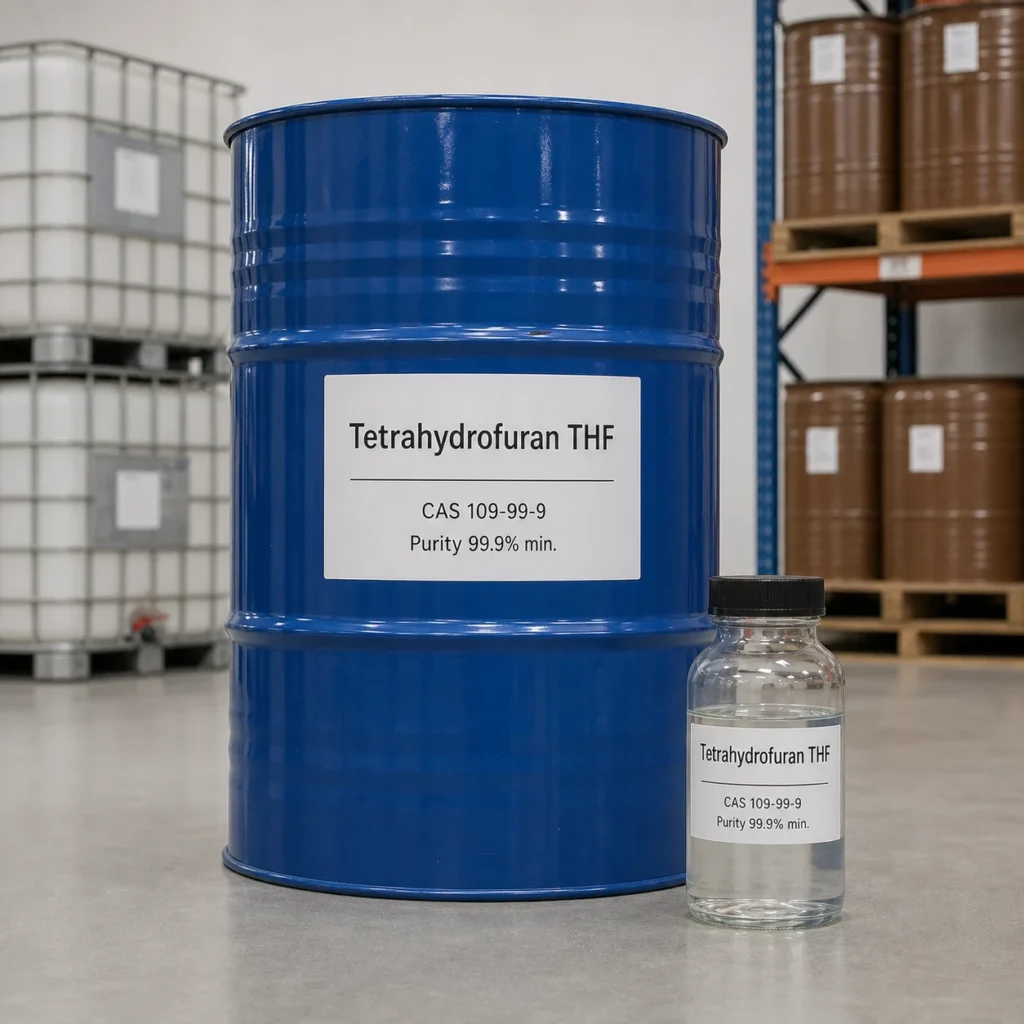
Tetrahydrofuran (THF) CAS 109-99-9 is reviewed by industrial buyers according to real application requirements, current batch specification, packaging, documentation and export feasibility. This article focuses on Industrial Applications and Use Scenarios and gives practical notes for procurement teams comparing suppliers and preparing quotation requests.
Product page: View Tetrahydrofuran (THF) specifications, packaging and quotation details.
Where Tetrahydrofuran (THF) Is Commonly Used
Tetrahydrofuran (THF) is typically considered as a polar ether solvent. Buyers should evaluate the material according to the actual production process rather than product name alone, because small specification differences can affect process stability, residue, odor, color, reaction behavior or downstream compatibility.
- reaction solvent for polymer, pharmaceutical, agrochemical and fine chemical synthesis
- processing solvent for resins, adhesives, coatings and specialty materials
- extraction and cleaning applications where solvency and low water content are important
- laboratory-to-industrial scale processes that require consistent evaporation behavior and batch traceability
Application Scenarios Worth Comparing
Tetrahydrofuran (THF) is commonly evaluated as a polar ether solvent. The same chemical can perform differently depending on purity, moisture, residue, packaging and the buyer’s process conditions, so application context should be shared before quotation.
In practical procurement, buyers usually compare how the product performs in target production, whether the grade is stable enough for repeat orders, and whether the supplier can support the documents required by internal quality and safety teams.
Product Snapshot
| Product | Tetrahydrofuran (THF) |
|---|---|
| CAS No. | 109-99-9 |
| Article Focus | Industrial Applications and Use Scenarios |
| Typical Checks | water content, inhibitor or stabilizer status where applicable, peroxide control, color, residue, purity, packaging tightness and current batch COA |
| Supplier Support | SDS, COA, TDS, packaging review, batch confirmation and export document coordination according to product and destination requirements. |
Quality and Batch Confirmation
Before confirming an order, buyers should review exact product identity, CAS number, current batch COA, purity, appearance, moisture or acidity indicators where relevant, packaging format, storage requirements and shelf-life expectations. For process-sensitive applications, a small trial or sample confirmation can help reduce purchasing risk.
A supplier should be able to explain available batch information clearly and coordinate documents quickly. For global procurement, this is especially important because the purchasing decision must satisfy technical users, quality teams, safety teams, logistics teams and sometimes customs or carrier requirements.
Packaging, Storage and Shipment
Packaging should be confirmed according to order quantity, destination, handling equipment and product properties. Buyers should check whether the product will be shipped in drums, IBC, ISO tank or other agreed packaging, and whether labels, palletizing or container loading requirements need to be prepared in advance.
THF should be reviewed carefully for flammability, peroxide formation risk, ventilation, sealed storage and storage-time control. Buyers should follow the latest SDS and internal safety rules before storage or use.
How to Request a Faster Quotation
For a faster response, send product name, CAS number, required purity, estimated quantity, destination country or port, target application, packaging preference and required documents. If the material is used in a formulation or reaction system, sharing key quality indicators helps confirm the suitable grade.
Related Procurement Links
Grade selection and source review
THF application fit should be judged against the actual process rather than a generic use list. Buyers should confirm assay, water, peroxide-related controls, inhibitor status where relevant, color and residue against the intended polymerization, synthesis or formulation step. Public identity and physical-property data can be checked through PubChem CID 8028; occupational safety information is available from the NIOSH Pocket Guide.
Reviewed and expanded: August 2026. Final approval must use the current batch COA, SDS and buyer specification.
Connecting common applications with fit-for-use evidence
THF is a volatile ether solvent valued for broad solvency and miscibility with water. It can form peroxides during storage, so inhibitor status, storage history and peroxide-control procedures belong in technical qualification alongside assay and water.
Application examples explain where a chemical is commonly considered; they do not prove that one commercial grade will work in every formulation or reaction. The buyer should validate compatibility, process performance, finished-product impact and exposure controls with a controlled sample or pilot trial.
Core parameters for Tetrahydrofuran (THF)
| Review point | Practical action |
|---|---|
| assay and identity | Specify limit, unit and method; compare the shipping-batch result. |
| water content | Specify limit, unit and method; compare the shipping-batch result. |
| peroxide result and test timing | Specify limit, unit and method; compare the shipping-batch result. |
| inhibitor status where applicable | Review when relevant to the approved process and destination. |
| colour, acidity and non-volatile residue | Review when relevant to the approved process and destination. |
Results must be interpreted as a group. A strong assay result does not cancel an unsuitable water, residue, inhibitor, acidity or impurity result. Method details matter as well: sample handling, calculation basis and reporting limits can change whether two COAs are genuinely comparable.
Sample approval and incoming inspection
For a new supplier or changed grade, request a current specification, representative COA and SDS before ordering. Test a representative sample using the receiving plant’s normal method and, where performance is process-sensitive, complete a documented laboratory or pilot trial. Record the approved grade, critical limits and acceptance decision.
Before shipment, review the actual batch COA. On receipt, verify package condition, product identity, lot number, net weight and required labels before sampling. A retained sample and receiving record make later quality investigations more reliable.
Commercial and logistics checklist
- Confirm product name and CAS number: Tetrahydrofuran (THF), 109-99-9.
- State grade, required specification, quantity and intended application.
- Agree package type, net weight and unloading requirements.
- Review the latest SDS and transport classification for the supplied grade.
- Confirm destination port or country, Incoterm and required export documents.
- Approve a sample and the shipping-batch COA before regular use.
Storage and handling must follow the latest SDS, local regulations and the buyer’s process-hazard review. Online procurement information is not a substitute for an operating procedure, exposure-control plan or legal advice.
Product page and quotation details
See the current Tetrahydrofuran (THF) product page. A useful quotation request should include grade, critical limits, quantity, package preference, application, destination and required documents. Xinchen can then review the offered material and route without implying suitability beyond the documented specification.
Authoritative references
Use the latest official records, current SDS and destination requirements when making safety, transport or compliance decisions.